
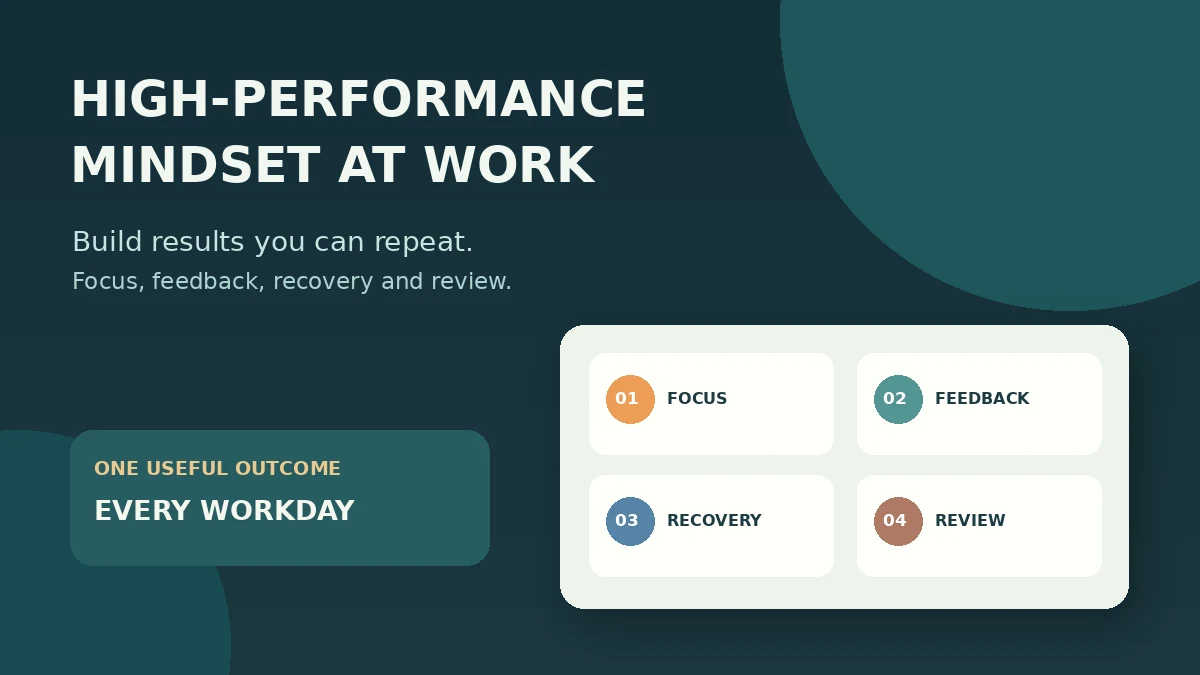
A high-performance mindset at work is not the belief that you must always be productive. It is a repeatable way to choose meaningful work, focus on it, use feedback, and recover enough to do it well again. People who sustain good work over time tend to rely on systems rather than a permanent state of motivation.
This guide explains six practical habits, a weekly scorecard, and a 30-day experiment. It is designed for employees, managers, and independent professionals who want more consistent results without making overwork a badge of honor.
What is a high-performance mindset at work?
Think of a high-performance mindset as a set of operating assumptions: results matter more than busyness; progress can be measured; feedback is information; skills improve through practice; and recovery is part of capacity. These are habits of attention and decision-making, not a personality type reserved for elite athletes or executives.
It helps to distinguish three ideas. Motivation is the desire to act. Discipline is following through when motivation varies. Performance is the quality and usefulness of the outcome. Someone can work long hours and still deliver poor results if they focus on the wrong tasks. Conversely, a shorter focused session may produce the work that matters most.
For a deeper look at follow-through, read our guide to self-discipline at work. Here we focus on the broader system that determines what deserves discipline in the first place.
Habit 1: Define the result before the activity
Before opening email or a project board, write one sentence: “By the end of today, the useful result will be ____.” Make it observable. “Work on marketing” is vague; “draft and review the three-email onboarding sequence” describes a deliverable.
Next, ask who benefits from the result and what “done” looks like. A manager might define success as a decision documented with owners and deadlines. A freelancer might define it as a client-approved draft, not hours spent editing. This prevents the common trap of mistaking motion for progress.
Choose one primary outcome and, if necessary, two supporting tasks. If everything is the highest priority, nothing is. The task prioritization guide provides methods for choosing when competing requests are genuinely urgent.
Habit 2: Protect a realistic focus window
Reserve one 45- to 90-minute block for demanding work, adjusted to your role and circumstances. Silence nonessential notifications, gather the material you need, and write down the next concrete action. If your job requires constant availability, negotiate a shorter protected window or a coverage arrangement rather than disappearing without agreement.
When an interruption arrives, capture it in a short list instead of immediately switching tasks. At the end of the block, record what was finished and what remains. A focus window is not successful because it lasted a particular number of minutes. It is successful if it moves the chosen deliverable forward.
If you are unsure how to place focus blocks on a crowded calendar, see our time-blocking guide. You can also compare time blocking with Pomodoro to choose a structure that fits your work.
Habit 3: Use feedback without turning it into a verdict
Ask for feedback on a specific decision or artifact, not on your worth as a person. “Which section of this proposal is least clear?” is easier to answer than “Am I good at this?” The narrower question produces information you can use.
Try a three-column note: observation, interpretation, and next action. Observation: two reviewers could not find the pricing assumptions. Interpretation: the document may bury important constraints. Next action: move assumptions to a short table near the top and test it with another reviewer. This creates a loop from evidence to improvement.
When feedback conflicts, look for patterns and context. A single opinion can reveal a problem, but it should not automatically override the project’s objective. Our guide to constructive feedback at work offers language for giving and receiving useful comments.
Habit 4: Build recovery into the plan
Sustained performance requires capacity, and capacity is affected by sleep, workload, stress, and the nature of the task. Working longer is not always the same as working better. The CDC’s National Institute for Occupational Safety and Health notes that work-related fatigue can reduce attention, short-term memory, and judgment.
Plan realistic breaks and end times. If a deadline requires a temporary surge, identify what will be deprioritized and when recovery will happen. A manager should look at workload and staffing, not simply tell employees to become more resilient. For jobs with safety risks, follow employer policies and relevant professional guidance.
You do not need an elaborate wellness routine to begin. Start by protecting an achievable end-of-day boundary and removing one recurring unnecessary meeting or notification. Our workday shutdown checklist gives a practical way to close the day.
Habit 5: Review decisions, not just task counts
At the end of the week, ask: Which result mattered? What absorbed time without adding value? What assumption proved wrong? What should I stop, start, or continue? A ten-minute review can reveal a pattern that daily task lists hide.
For example, a project lead may complete 38 tasks but repeatedly postpone a difficult stakeholder decision. The task count looks impressive; the bottleneck remains. Next week, the lead schedules the decision first, prepares two options, and asks for a clear deadline. This is performance management, not a productivity contest.
Structured reviews have a research basis. A meta-analysis of individual and team debriefs found that deliberate reviews can improve effectiveness on average across studied settings. Use the finding as a reason to test a review practice, not as a promise of a particular percentage improvement in your workplace.
Habit 6: Design for consistency rather than intensity
A demanding new system often works for three days and then collapses. A sustainable system has a minimum version for busy days. Your normal plan might include a 60-minute focus block, a 10-minute review, and one feedback request. Your minimum plan might be 15 minutes on the top priority plus a two-sentence handoff note.
This matters because calendars, caregiving responsibilities, and unpredictable work do not always allow ideal conditions. Consistency means returning to the process after disruption, not meeting an arbitrary streak. If a routine repeatedly fails, change the design rather than accusing yourself of insufficient willpower.
The weekly high-performance scorecard
Use this scorecard as a conversation with yourself or your team. Do not turn it into a public ranking or use it to evaluate people without context. The numbers are prompts for discussion, not a scientific personality assessment.
| Signal | Weekly question | Example evidence |
|---|---|---|
| Outcomes | Did I finish the one most valuable deliverable? | Approved draft, shipped fix, resolved decision |
| Focus | Did I protect meaningful time for difficult work? | Two or three completed focus blocks |
| Feedback | Did I get one useful outside perspective? | A reviewer comment and a revision |
| Learning | Did I test one improvement? | Change logged and checked |
| Recovery | Was the workload sustainable? | Breaks, realistic finish times, fewer late surprises |
Give each row a simple status: working, needs adjustment, or not observed. Avoid inventing a score when you lack evidence. At the end, choose only one change for next week. If you have several competing options, our weighted decision matrix template can help compare trade-offs explicitly.
A 30-day experiment you can actually run
Week 1: Baseline. Record your main deliverable, how long meaningful work took, where interruptions came from, and whether you had enough recovery time. Do not change everything yet.
Week 2: Focus. Protect a realistic work block on three days. Keep a short interruption log and compare the quality of your output with the baseline.
Week 3: Feedback. Ask one colleague or client for a targeted review. Change one part of your workflow based on a clear observation.
Week 4: Review. Compare outcomes, workload, and sustainability. Keep what helped, remove what added administration, and set one measurable next experiment.
The purpose is not to prove you are a “high performer” after 30 days. It is to discover a work pattern that improves results without creating avoidable strain.
Common mistakes that undermine performance
Confusing urgency with value: an overflowing inbox can feel productive while important work stalls. Protect time for the work that changes the outcome.
Treating rest as a reward: recovery is a capacity constraint, not a prize for finishing everything. Unchecked fatigue can make the next day harder.
Copying someone else’s routine: an executive’s schedule may not fit a teacher, shift worker, caregiver, or freelancer. Adapt the principle to the environment.
Using metrics without context: output counts can reward shallow work. Combine quantity with quality, stakeholder value, and sustainability.
Skipping the review: without a feedback loop, a habit can become ritual. Ask whether it still serves the goal.
A high-performance mindset is best demonstrated by choices you can repeat: identify the right result, protect attention, learn from feedback, and recover. Start with one habit and a weekly review, then let evidence shape the next adjustment.
Frequently asked questions
Is a high-performance mindset the same as working longer hours?
No. It focuses on useful outcomes, attention, feedback, and recovery. Longer hours can sometimes increase fatigue without improving the quality of results.
How can I develop a high-performance mindset if my schedule is unpredictable?
Start with a minimum version: one clearly defined outcome, a short focus window when possible, and a two-minute review. Adapt the routine to your job and responsibilities.
What should I measure each week?
Track a meaningful deliverable, opportunities for focused work, one useful feedback cycle, a small improvement test, and whether the workload was sustainable. Interpret these signals in context rather than using a rigid score.