
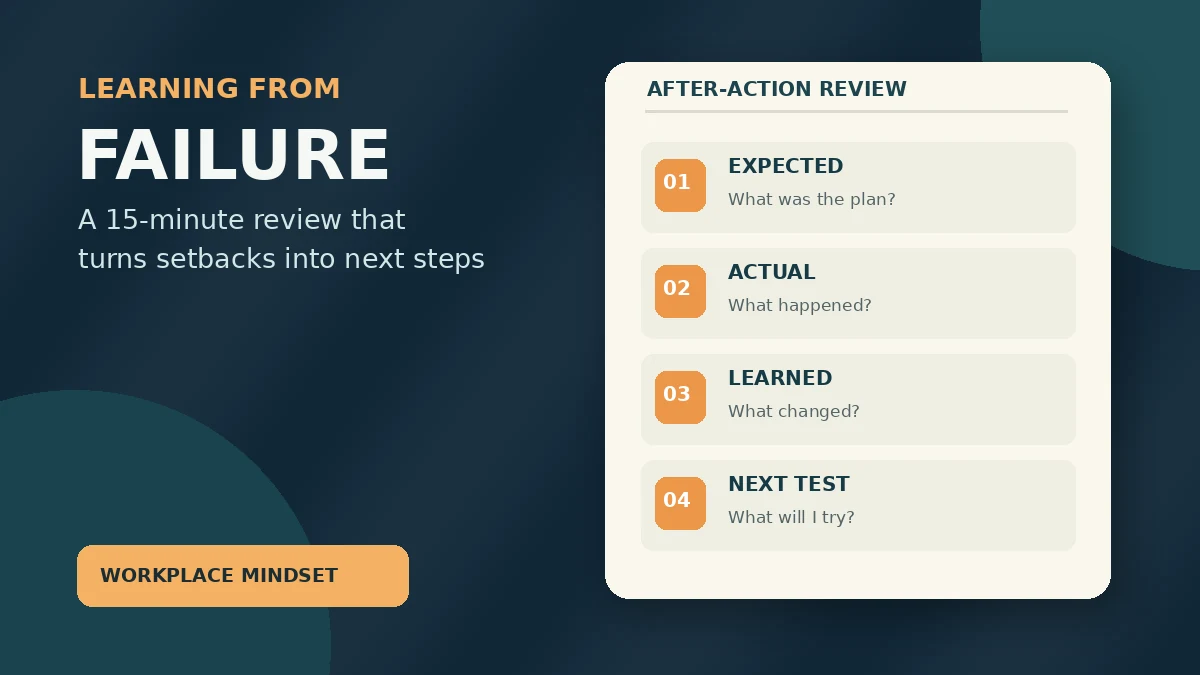
A project missed its deadline. A proposal was rejected. A presentation fell flat. The useful question is not whether the outcome feels disappointing. It is what the experience can teach you before the next attempt. Learning from failure at work is a practical skill: you separate what happened from the story you tell yourself, identify factors you could influence, and test one improvement.
This guide gives you a 15-minute review, a copyable worksheet, and examples for employees, freelancers, and team leads. It is about learning from a specific event, not pretending that every setback is a gift or blaming yourself for circumstances outside your control.
What learning from failure at work actually means
Learning from failure means examining an outcome against an expectation, using evidence to understand the gap, and changing a decision, process, or assumption. A missed target is information, but it does not automatically explain why the target was missed. The review creates that explanation carefully.
A useful review answers four questions:
- What did we expect to happen? Name the target and the assumptions behind it.
- What actually happened? Use dates, numbers, messages, or observable events.
- Why might there be a gap? Separate controllable choices from constraints and uncertainty.
- What will we try next? Pick a small change that can be observed or measured.
This differs from simply adopting a positive attitude. Optimism may help someone continue, but a new process is what turns the lesson into an operational improvement. For the emotional side of a difficult result, see our guide to building resilience at work. If fear prevents you from trying in the first place, the separate guide on overcoming fear of failure at work addresses that problem.
The 15-minute failure review template
Set a timer and complete this after a specific event. If emotions are still running high, wait until you can describe facts without attacking yourself or someone else. A review is not an investigation of misconduct or a substitute for a formal incident process.
| Time | Question | Write down |
|---|---|---|
| 0–3 minutes | What was the plan? | Goal, deadline, success measure, initial assumptions |
| 3–6 minutes | What happened? | A short timeline and two or three verifiable observations |
| 6–10 minutes | What contributed? | Decisions, missing information, dependencies, outside constraints |
| 10–13 minutes | What is one better experiment? | One change, owner, deadline, expected signal |
| 13–15 minutes | When will I check? | Review date and a simple pass/fail or progress indicator |
Copyable worksheet: Expected outcome: ____. Actual outcome: ____. Evidence: ____. My controllable contribution: ____. External factors: ____. Assumption to test: ____. One change: ____. Review date: ____.
Do not fill every blank with a long explanation. One specific sentence in each field is usually more useful than a page of general reflection. Keep private or sensitive client information out of shared templates.
Example 1: A freelancer loses a proposal
Imagine you quoted a website project and the client chose another provider. The first reaction might be, “My prices are too high.” That conclusion is premature. You do not yet know whether the deciding factor was price, timing, portfolio fit, communication, or an internal change at the client’s business.
Your review could record: the proposal arrived two days after the requested date; it described deliverables but not acceptance criteria; and no budget range was discussed before quoting. The next experiment is to ask about the budget and decision process on the discovery call, then send a one-page scope summary within 24 hours. Measure whether the next five qualified proposals receive clearer responses. This does not guarantee more wins, but it creates a testable learning loop.
The related freelance proposal template helps turn the lesson into a more precise proposal. If repeated requests change after agreement, use the scope creep prevention guide rather than treating every change as a personal failure.
Example 2: A team misses a delivery date
Suppose a team planned to release a feature on Friday but finished the following Tuesday. A blame-oriented meeting asks who failed. A learning-oriented review maps dependencies: design approval arrived late, testing began only after development, and the estimate assumed an integration would work on the first attempt.
The team cannot control every outside dependency. It can, however, introduce an approval cutoff, begin testing on a smaller component earlier, and add an explicit uncertainty allowance for unfamiliar integrations. Assign each improvement to a person and check it at the next milestone. Without an owner or a follow-up date, the “lesson learned” is just a meeting note.
Research on structured debriefs supports treating review as a process rather than a motivational speech. A meta-analysis published in Human Factors examined individual and team debriefs across settings and found meaningful average improvements in effectiveness. That finding supports deliberate reflection, but it does not mean every team will see the same result.
Seven rules for a useful learning mindset
1. Describe behavior, not identity
“I sent the estimate without confirming the requirements” is actionable. “I am bad at business” is a global judgment that gives you nothing to change. Replace labels with observable actions. The point is accountability without turning one event into a permanent self-description.
2. Keep the review narrow
Pick one event, one decision, or one missed expectation. If you review your entire career every time something goes wrong, you will struggle to find a next action. A narrowly scoped review is easier to repeat and compare.
3. Look for disconfirming evidence
If your first explanation is “the customer only cared about price,” ask what would show that explanation is wrong. Did the customer request a faster delivery? Did they ask for experience in a particular industry? Could unclear scope have mattered? Treat the first explanation as a hypothesis.
4. Separate control from influence
You control your preparation, communication, and follow-up. You may influence a client’s expectations. You cannot control a competitor’s offer or a sudden market shift. Assign improvements only where you have a realistic ability to act. This prevents the review from becoming an exercise in unfair self-blame.
5. Change one variable at a time when possible
If you revise your pitch, price, process, and target audience simultaneously, it is hard to know what helped. In real work you cannot always run a controlled experiment, but small changes make patterns easier to notice. For decision-making under uncertainty, use our five-step decision framework.
6. Make the next step small enough to complete
“Become more confident” is not a test. “Rehearse the first two minutes of my presentation three times and ask a colleague for feedback” is. Choose an action that fits the next week, not a sweeping reinvention that requires perfect motivation.
7. Review the review
After two to four weeks, ask whether the change was implemented and whether the expected signal moved. If not, the lesson may be incomplete. A failed experiment can still reveal a better question. Keep a brief log so you do not repeat the same untested resolution after every setback.
When a personal review is not enough
Some failures arise from overloaded teams, unclear management priorities, unsafe work, discrimination, or missing resources. An individual checklist cannot fix a structural problem. Document the facts, raise the issue through the appropriate channel, and ask for a process change. When the event involves safety, privacy, or legal duties, follow the organization’s formal procedures first.
Also, avoid demanding immediate optimism from someone who has experienced a serious loss. Give people space to process the event. A learning review is most useful when participants can speak accurately and without fear of humiliation. A review in Academy of Management Annals describes how the opportunity, motivation, and ability to learn from errors all matter, and how punitive environments can hinder learning.
A simple weekly habit to keep lessons visible
On Friday, take five minutes to record one decision that worked, one result that surprised you, and one adjustment for next week. Review the previous entry before starting. This balances learning from mistakes with noticing what should be repeated. If your workload makes reflection difficult, add it to a short workday shutdown routine rather than creating another elaborate system.
The aim is not to eliminate failure. It is to reduce repeated, preventable mistakes while keeping room for thoughtful experimentation. Start with one recent event, complete the 15-minute worksheet, and put the next review date on your calendar.
Frequently asked questions
How do I learn from a mistake at work without dwelling on it?
Write down the expected outcome, the actual result, one controllable factor, and one small change to test. Set a review date and then return to your work rather than repeating the same self-criticism.
What is the difference between a failure review and blaming someone?
A useful review examines evidence, assumptions, process gaps, and next actions. Blame focuses on personal labels or punishment. Formal accountability processes may still be needed for serious misconduct or safety incidents.
How soon after a setback should I do an after-action review?
Review while details are still available, but not while emotions make factual discussion difficult. For serious incidents, follow the required reporting and safety procedures first.