
A long job search can make motivation feel like a daily referendum on your worth. Applications disappear into inboxes, interviews end without an offer, and even well-prepared candidates may receive little feedback. The useful question is not how to feel enthusiastic every morning. It is how to stay motivated during a long job search while making decisions that protect your energy, improve the quality of your applications, and give you a realistic way to measure progress. This guide offers a weekly system you can adapt to your time, financial needs, responsibilities and local job market.
Quick answer: Set a manageable weekly schedule, target a small number of relevant roles, track actions you control, review the quality of your applications, and include recovery time. Treat rejections as information to examine rather than proof that you are inadequate. If financial pressure makes a slow search impossible, prioritize immediate income options and available support alongside longer-term applications.
Why motivation falls during a job search
A job search combines uncertainty, delayed feedback and limited control. You can prepare carefully and still be competing with applicants you never see. Hiring freezes, location constraints, job requirements, internal candidates and timing all affect outcomes. It is therefore misleading to interpret every silence as a judgment about your ability. At the same time, sending identical applications endlessly can create the appearance of activity without improving the odds of reaching a relevant employer.
The American Psychological Association has discussed the emotional strain of searching for work and the importance of a sustainable schedule and support. That does not mean a single routine cures distress or guarantees an offer. It means you can structure the work so that effort, learning and rest are visible. If stress becomes overwhelming or interferes significantly with daily functioning, seek appropriate professional or community support rather than treating this article as mental-health care.
Step 1: Define a realistic weekly capacity
Start with the hours you actually have, not the hours an idealized job seeker would have. Caring for children, working part-time, disability, transport limits and unreliable internet can all constrain the schedule. Decide how many focused blocks are sustainable. For example, three 60-minute sessions may be more productive than promising yourself six hours every day and repeatedly failing to meet the target. A plan you can repeat for a month is preferable to a dramatic burst that leaves you exhausted.
Separate your search into four tasks: finding relevant openings, tailoring applications, contacting people or organizations, and practicing interviews or updating skills. Do not let browsing job boards consume every session. If you have only two hours per week, choose the highest-value tasks and reduce the volume target. Use our productivity systems guide to set up a simple recurring review without creating an elaborate dashboard.
Step 2: Make a shortlist instead of applying everywhere
Write down your nonnegotiable constraints first: location or remote eligibility, pay floor, required hours, work authorization, qualifications, and accessibility needs. Then create a shortlist of roles where your experience plausibly matches the essential requirements. A job posting can be aspirational; it is not always a checklist you must satisfy perfectly. But repeatedly applying to positions that clearly require credentials you do not have may drain time that could be spent on realistic opportunities.
For each promising role, identify two or three achievements you can demonstrate. Replace generic claims such as “hard worker” with concrete evidence: improved a process, handled a customer issue, reduced errors, organized an event, or learned a tool. Avoid inventing numbers or responsibilities. If you lack direct experience, explain transferable skills and a relevant example. Tailoring should improve clarity, not exaggerate your background.
Step 3: Use a simple application tracker
Your tracker needs only a few columns: employer, role, application date, source, tailored evidence, next action, follow-up date and outcome. Store it privately; do not publish employers’ contact details or personal information. You can use a notebook or spreadsheet. The purpose is to prevent duplicate applications and spot patterns, not to monitor yourself every hour.
| Role | Evidence tailored | Next step | Review date |
|---|---|---|---|
| Customer support coordinator | Resolved complex customer issues | Check employer’s stated timeline | Next Friday |
| Operations assistant | Maintained accurate records | Prepare interview example | Tuesday |
| Administrative associate | Scheduled multi-team projects | Send relevant portfolio sample if requested | Thursday |
The sample above is fictional. Use follow-up dates only when appropriate to the employer’s instructions. Repeated messages can become counterproductive. If a posting explicitly says not to contact the employer, respect that. If you hear nothing, close the record after a reasonable period and redirect attention to new opportunities.
Step 4: Measure quality signals, not just applications sent
Application volume is easy to count but can hide poor targeting. At the end of each week, note how many roles matched your criteria, how many applications were tailored, how many conversations provided useful information, and what you learned. Interviews and offers matter, but they depend on employers. Process measures show whether your approach is changing. Do not assume a particular response rate is normal for every occupation or region.
A practical review might reveal that twenty generic applications generated no responses, while four carefully targeted applications led to a conversation. That is not proof that four is the magic number. It is a reason to examine which roles, resumes or referral channels deserve more attention. If nothing works for several weeks, ask a trusted person or local career service to review one anonymized application and identify a specific improvement.
Step 5: Make rejection reviews brief and factual
After a rejection, allow yourself to be disappointed without turning it into a sweeping conclusion. Then ask three questions: What did I know about the role? What evidence did I provide? What could I change next time? If the employer gave no feedback, write “unknown” rather than inventing a reason. A short review keeps you learning without spending hours replaying an interview. Our 15-minute learning-from-failure template can be adapted to this purpose.
If you receive a clear pattern of feedback—perhaps your examples are vague or your interview answers are too long—practice one improvement before the next opportunity. For interviews, a concise situation-action-result story can help explain your contribution without turning the conversation into a rehearsed monologue. When possible, practice with someone who can ask follow-up questions and give specific, respectful feedback.
Step 6: Protect time away from the search
Motivation is not an unlimited resource. Put a finish time on job-search blocks and schedule activities that restore attention: movement, a meal with someone, a hobby, volunteering if feasible, or simply a period without job notifications. These are not rewards you must earn by submitting enough applications. They are ordinary parts of a sustainable week. If you are under financial pressure, rest may be harder to arrange; even short, predictable breaks can help you keep going.
Avoid comparing your timeline with curated success stories online. Another person’s hiring speed depends on their industry, location, network and circumstances. Social platforms can provide leads, but constant comparison may encourage unproductive application sprints. Turn off notifications outside your chosen search window if they interrupt sleep or other responsibilities. Our realistic morning routine offers an optional structure, not a requirement to wake up early.
Step 7: Keep a backup plan visible
A long search is not only a mindset challenge; it can be a financial problem. Make a clear list of essential expenses, available savings, benefit eligibility, temporary work options and deadlines. Consider whether a part-time role, contract project, skills course or local employment service is realistic without undermining the main search. Verify local labor rules and benefits before making decisions. You do not need to treat a temporary income source as a personal failure.
If debt or missed payments are becoming urgent, seek reputable local advice and contact providers early to understand options. Do not pay someone who guarantees employment or asks for sensitive financial credentials to “unlock” a job. Genuine employers may have screening steps, but a request to transfer money to obtain a position is a warning sign. Your financial safety is more important than maintaining an impressive-looking application count.
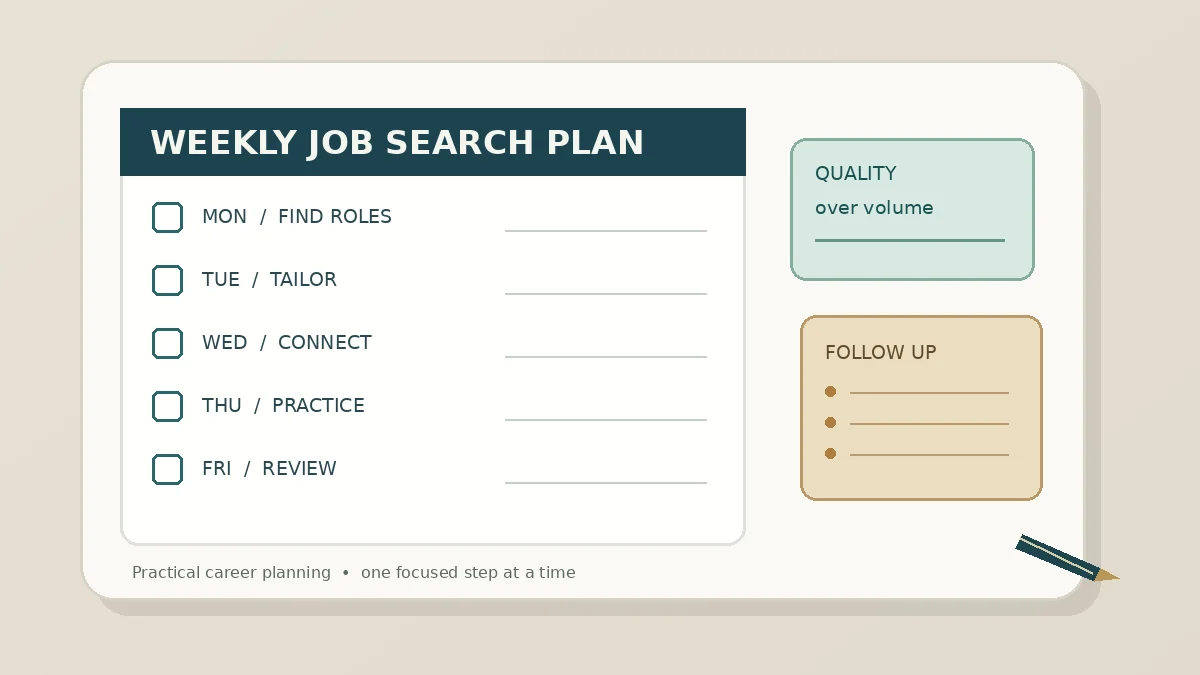
A repeatable five-day job-search schedule
| Day | Focused task | Evidence of progress |
|---|---|---|
| Monday | Identify 3–5 realistic openings | Shortlist with requirements and deadlines |
| Tuesday | Tailor applications | Role-specific examples, no invented claims |
| Wednesday | Network or request information | One useful conversation or carefully written note |
| Thursday | Practice one interview skill | Recorded or written example revised |
| Friday | Review outcomes and next steps | One change to test next week |
This is a template, not a quota. Someone with shift work may complete all five tasks over two days; someone with caregiving responsibilities may need two weeks. The important distinction is between tasks that produce useful evidence and tasks that only fill time. End each week by choosing one adjustment, such as improving the opening paragraph of your resume or targeting a more specific role family.
When to change strategy
If you have had no meaningful responses after several weeks, do not automatically double your application volume. Review role fit, location restrictions, resume clarity, application channels, interview preparation and the health of the local market. Ask whether you are applying to active openings or repeatedly encountering stale listings. Consider a career service, professional association, alumni group or community organization for feedback. CareerOneStop provides U.S.-focused tools for skills matching and exploring occupational transitions; outside the United States, look for equivalent official services.
For a broader view of sustainable performance, see high-performance habits at work and career growth mindset. Neither guide replaces direct feedback from employers or local labor-market information.
Sources and editorial limits
The American Psychological Association’s job-search preparation guide discusses realistic scheduling, interview preparation and maintaining support. The APA’s summary of job-search intervention research highlights the value of combining skills practice with motivation support. For skills exploration, the U.S. Department of Labor’s CareerOneStop Skills Matcher is one official resource. These sources inform the structure; the sample tracker and weekly schedule are original editorial tools, not a scientifically validated formula. Outcomes depend on employers, markets and individual circumstances.
Frequently asked questions
How can I stay motivated after repeated job rejections?
Use a short factual review of each application or interview, note what you can change, and keep a sustainable schedule. Do not assume silence proves you lack ability. Seek feedback and support when possible.
How many jobs should I apply to every week?
There is no universal number. Choose a volume that lets you target relevant roles and submit accurate, tailored applications while meeting your other responsibilities. Review the quality of responses rather than copying someone else’s quota.
Should I take a break from job searching?
Planned breaks can be part of a sustainable schedule. If you face urgent financial needs, balance recovery time with practical income and support options. If distress becomes severe, seek appropriate professional help.