
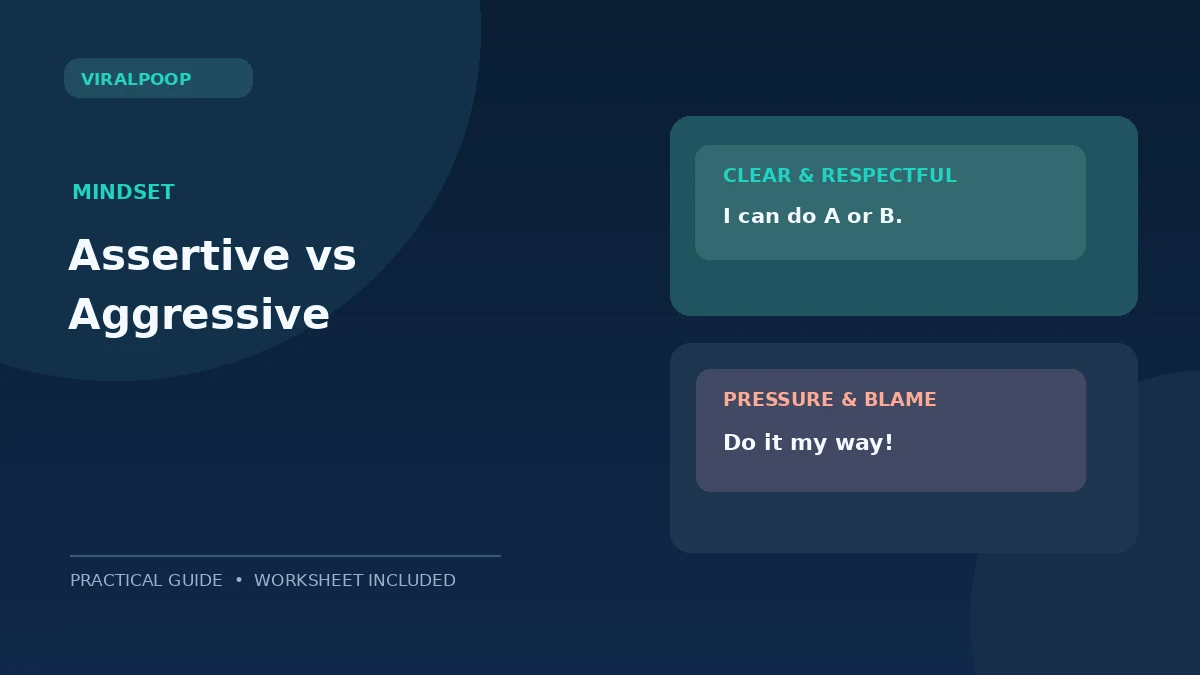
Knowing the difference between assertive and aggressive communication is easier in theory than in a tense meeting. Both can sound direct. The difference is whether the speaker clearly protects a legitimate need while respecting the other person’s right to respond. This guide turns common workplace conflicts into practical scripts you can adapt without sounding apologetic or combative.
These examples are written for everyday professional situations: workload, missed deadlines, interruptions, client requests, feedback, and disagreements with a manager. They are not a substitute for HR procedures when bullying, discrimination, threats, or safety concerns are involved.
Key takeaways
- Assertive: clear about needs, boundaries, and next steps while respecting the other person.
- Aggressive: attacks, intimidates, or attempts to win through pressure.
- Passive: avoids voicing a legitimate need; passive-aggressive: communicates resentment indirectly.
- A useful script has four parts: observable fact, impact, request, and invitation to respond.
Assertive vs aggressive: the difference in one table
| Behavior | Assertive | Aggressive |
|---|---|---|
| Goal | Explain a need and seek a workable outcome | Force agreement or establish superiority |
| Words | Specific observations and requests | Insults, threats, sweeping blame |
| Listening | Leaves room for questions or disagreement | Interrupts or dismisses other perspectives |
| Boundary | States what you can or cannot do | Attempts to control the other person |
| Example | “I can finish A today or B tomorrow. Which is the priority?” | “Your priorities are ridiculous. Stop changing them.” |
Assertiveness is not always gentle or agreeable. Saying “I cannot take that assignment without removing another commitment” is firm, even when the listener dislikes it. Conversely, quietly agreeing and later retaliating can create its own problems. The U.S. Department of Veterans Affairs workplace toolkit distinguishes assertive communication from aggression by pairing self-respect with respect for others.
Eight workplace situations: weak, aggressive, and assertive responses
1. A manager adds urgent work to a full schedule
Passive: “Sure, I guess I can do everything,” even though the deadline is impossible. Aggressive: “This is terrible management. Figure it out yourself.” Assertive: “I have two deliverables due today. I can take the new request if we move one deadline. Which project should take priority?”
The assertive version does not pretend capacity exists. It turns the disagreement into a concrete scheduling decision and documents the trade-off.
2. A coworker repeatedly interrupts you
Passive: Stop talking and avoid the discussion. Aggressive: “You’re always rude and you never let anyone speak.” Assertive: “I’d like to finish my point, then I’m happy to hear your view. I need about thirty seconds.”
Make the request short and immediately return to your point. If interruption continues, a private conversation may be more productive than escalating in front of others. See our interruption recovery guide for protecting focus after unexpected disruptions.
3. A colleague sends incomplete information
Aggressive: “You clearly don’t know how to do this.” Assertive: “The handoff is missing the approved figures for sections two and three. I need those before I can finalize the report. Can you send them by 2 p.m. or tell me when they will be ready?”
Notice the focus on the deliverable rather than on the person’s character. This also gives the colleague a clear opportunity to correct the problem.
4. Someone criticizes your work in a meeting
Passive: Agree without asking for specifics. Aggressive: “You don’t understand this project.” Assertive: “I want to improve the result. Could you point to the section that missed the requirement and explain what you expected?”
If the feedback includes a genuine error, acknowledge it. Assertiveness does not mean defending every decision. Our guide to requesting useful feedback covers follow-up questions in more detail.
5. A client requests work beyond the agreed scope
Aggressive: “That’s not my problem. Read the contract.” Assertive: “The original quote includes two design options. I can price a third option separately and show you how it affects the delivery date. Would you like an estimate?”
You can be helpful without giving away additional work. For a fuller change-control method, use our freelance scope-creep guide.
6. You disagree with a supervisor’s decision
Aggressive: “That plan will fail. You’re ignoring everyone.” Assertive: “I see the speed advantage. My concern is that we have not tested the checkout change. Could we run a small test before rolling it out to everyone?”
Frame disagreement around the decision’s risks and possible alternatives, not a contest of authority. In a high-risk environment, consider the safest appropriate reporting channel.
7. A teammate messages you outside work hours
Passive: Answer every time, then feel resentful. Aggressive: “Stop bothering me at night.” Assertive: “I review routine messages during working hours and will respond tomorrow morning. For production emergencies, please use the on-call channel.”
Boundaries work better when you provide a clear process for urgent exceptions. The article how to set boundaries at work explains how to agree on expectations in advance.
8. A colleague takes credit for your contribution
Aggressive: “You’re a liar and a thief.” Assertive: “I want the project recap to reflect the work accurately. I developed the initial analysis and you completed the presentation. Can we update the summary to name both contributions?”
If it becomes a persistent pattern or involves formal performance evaluation, keep evidence and use established workplace channels. You do not have to resolve a serious dispute through one informal conversation.
Use a four-part assertive communication script
A reusable structure is Fact → Impact → Request → Response. It is a writing aid, not a psychological diagnosis or a formula that always works.
- Fact: Describe what anyone present could verify. “The handoff arrived after the agreed review time.”
- Impact: State how it affects work. “That leaves less time for quality checks.”
- Request: Ask for a concrete behavior. “Could future handoffs arrive by Wednesday noon?”
- Response: Make room for context. “Is there a blocker we should plan around?”
Put together: “The handoff arrived after our agreed review time, which left less time for quality checks. Could we set Wednesday noon as the standard deadline? Is there a dependency making that difficult?” This is direct without guessing that the other person is lazy or careless.
The University of Iowa’s communication guide explains why direct requests and “I” statements can be useful. However, an “I” statement is not automatically respectful. “I think you are incompetent” remains a personal attack. State the behavior and the effect instead.
Before you speak: a 30-second tone checklist
- Facts: Am I describing an event or assigning a motive?
- Volume: Can I speak clearly at an ordinary level?
- Precision: Does the other person know exactly what I am requesting?
- Choice: Am I describing my boundary rather than issuing a personal threat?
- Listening: Can I hear relevant context before deciding?
- Setting: Is this a private matter that should not be raised publicly?
Respectful eye contact, pacing, and gestures vary across cultures and accessibility needs. Do not treat one communication style as proof of honesty or confidence. Focus on the actual message and whether people can participate safely.
Practice in five minutes with a script worksheet
Minute 1: Write down one situation you keep avoiding. Example: “I received three additional tasks after my schedule was finalized.”
Minute 2: Separate facts from assumptions. “Three tasks were added on Tuesday” is observable; “My manager doesn’t respect me” is an interpretation.
Minute 3: Write a request you can realistically make. “Can we agree which task moves to Friday?” beats “Please respect my time.”
Minute 4: Read it aloud. Remove accusations, sarcasm, and unnecessary apologies. You can be courteous while keeping the boundary intact.
Minute 5: Rehearse two possible responses: agreement and resistance. If the other person says no, you might ask which trade-off they recommend or document the impact.
For recurring workplace conflicts, record the date, situation, request, response, and what happened next. Look for evidence that your wording becomes more precise, rather than judging success by whether the other person always agrees.
When assertiveness is not enough
Assertive communication is a valuable everyday skill, but it should not become an obligation to negotiate with harassment, threats, or discriminatory conduct. Use workplace safety procedures, HR channels, union representation, professional support, or emergency services as appropriate. If there is a significant power imbalance, consider a written request or support person.
For related communication skills, review active listening examples and difficult conversations at work. Those pages focus on listening and preparing conversations; this one focuses on distinguishing direct boundaries from hostile behavior.
Frequently asked questions
Can being assertive sound rude?
A firm boundary may disappoint someone, but it is not automatically rude. Check whether you are addressing an observable issue respectfully and allowing a response rather than insulting or threatening the person.
What is a simple assertive sentence at work?
“I can finish the report by Thursday if we move the additional request to Friday. Which should take priority?” This identifies the constraint and asks for a practical choice.
Is raising your voice always aggressive?
Volume alone is not decisive; context matters. Aggression is more closely associated with intimidation, hostile language, threats, or disregard for the other person’s rights.
What is the difference between passive-aggressive and assertive?
Assertive communication expresses the concern openly and respectfully. Passive-aggressive behavior often communicates resentment indirectly through sarcasm, avoidance, or withholding cooperation.
How do I respond to an aggressive coworker?
Keep your response factual, avoid matching insults, and state a boundary such as “I can discuss the deadline when we can speak respectfully.” If behavior threatens safety or involves harassment, use appropriate reporting channels.