
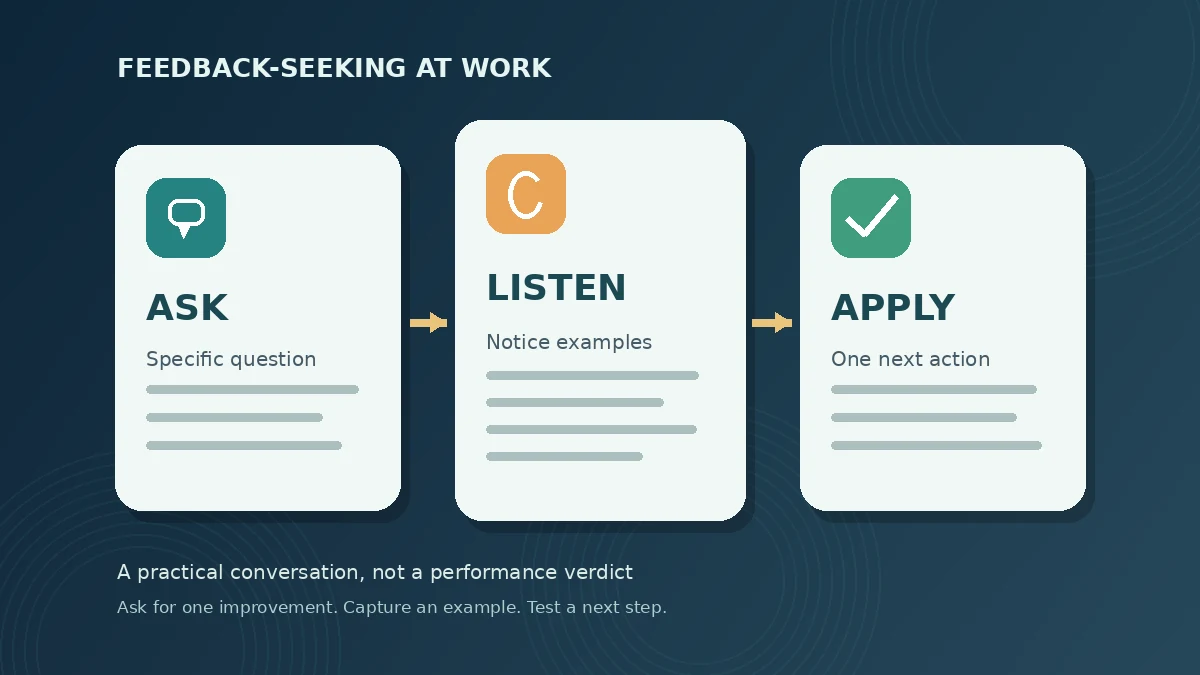
Knowing how to ask for feedback at work is a practical career skill. The difference between “How am I doing?” and “What is one thing I could change in the next client presentation?” can be the difference between a polite compliment and information you can use. You do not need a perfect manager, an annual review, or a dramatic confidence boost to start. You need a narrow question, an appropriate person, and a simple way to act on the answer.
This guide offers 12 specific questions, message templates for different relationships, a three-column follow-up tracker, and safeguards for biased or unsafe feedback. It focuses on requesting developmental input; if you are a manager trying to deliver feedback, see our separate guide to giving constructive feedback.
Why ask for feedback instead of waiting for a review?
Formal performance reviews may be infrequent, broad or tied to evaluation. A short request after a relevant piece of work can give you a clearer example while the context is fresh. But more frequent is not always better: the right timing depends on the task, team and relationship. The CIPD evidence review emphasizes fairness, relevance, two-way discussion and timing suited to the situation, rather than indiscriminately pushing immediate feedback.
Research on feedback-seeking behavior finds associations with performance and learning-related outcomes, but correlation does not prove that simply asking a question causes better work. A 2021 review of longitudinal studies noted the need for more research to clarify effects on performance. Treat a feedback request as an information-gathering step, not a promise of promotion or higher pay. See the longitudinal research review.
The three-part method: ask, listen, apply
- Ask: Choose a specific work sample and one skill you want to improve. Request a short conversation or a brief written answer, giving the other person room to decline or choose a better time.
- Listen: Ask for an example and clarify what success would look like. Resist debating every point in the moment; record the useful part and check your understanding.
- Apply: Select one small change, test it on the next similar task, and report back if appropriate. If the feedback is vague, biased or contradictory, seek another perspective before acting.
The strongest request is both focused and low-pressure. “Could you spare five minutes to tell me what I should change in the next version of this proposal?” gives the reviewer a task, an outcome and a reasonable time boundary. It is much easier to answer than “Please tell me everything I need to improve.”
12 feedback questions you can use at work
Select two or three questions for the situation rather than sending the whole list. Some are useful after a presentation, some during collaboration, and others when you are preparing for a new responsibility.
| When to ask | Question | What it reveals |
|---|---|---|
| After a presentation | Which part of the explanation was least clear, and what would you change first? | A specific communication improvement. |
| After a project | If we repeated this project, which step should I handle differently? | Process improvement without a personal verdict. |
| Before the next deliverable | What would make the next draft more useful to the reader or client? | Forward-looking quality criteria. |
| During onboarding | What is one common mistake new team members make here? | Local expectations and avoidable friction. |
| After a meeting | Was there a question I should have asked but missed? | Preparation and listening gaps. |
| When collaborating | Where did my handoff make your work easier or harder? | Impact on colleagues. |
| When priorities shift | Which outcome should I protect if time becomes limited? | Decision criteria and scope. |
| After handling a problem | What signal should I have noticed sooner? | Early warning signs. |
| Before a promotion conversation | What evidence would demonstrate readiness for the next level? | Observable criteria rather than vague reassurance. |
| When learning a tool | Which one workflow should I practice until it becomes reliable? | A targeted practice plan. |
| After receiving praise | What did I do that was especially useful, so I can repeat it? | A reproducible strength. |
| After constructive criticism | What would a better version look like in one concrete example? | A practical standard to test. |
Three ready-to-adapt request scripts
A short message to your manager
“Hi [name], I am improving how I summarize project decisions. After Thursday’s meeting, could I ask for five minutes of advice? I would especially value one example of what I should do differently in the next recap. If this week is busy, I can send the draft and ask asynchronously.”
This script respects time, names a work sample and asks for future-oriented advice. It also avoids turning the request into an unplanned performance appraisal. You can adjust the timing and channel to the manager’s normal communication style.
A peer-to-peer request
“I want to make our handoffs easier. Was there anything in the last file I sent that slowed you down? If so, what format or detail would help next time? A quick note is enough.”
Peers often see problems that a manager misses, especially in shared workflows. Do not ask a colleague to assess your entire performance or share private information about other team members. Ask about the collaboration they directly experienced.
A client or stakeholder request
“Before I finalize the next version, which one section would you most like simplified or expanded? A specific example would help me make the revision more useful.”
Clients may care more about outcomes, clarity and turnaround than your internal process. Keep the question tied to the deliverable and the agreed scope. If the response introduces a new requirement, discuss timing and budget rather than treating it automatically as a free revision. Our scope-creep prevention guide can help frame that conversation.
Should you ask for advice or feedback?
Both terms can be useful, but the wording can influence the answer. A study discussed by Harvard Business School Working Knowledge in January 2026 found that requesting forward-looking advice could produce more concrete developmental suggestions than asking for retrospective feedback. The researchers did not establish that recipients implemented the advice or that their subsequent performance improved. The sensible application is modest: when you need a next step, ask what to try differently next time.
If you need to know whether an agreed standard was met, direct feedback about the completed work may be more appropriate. If you need to plan the next iteration, a request for advice can invite more specific suggestions. Do not use word choice to manipulate a colleague into an evaluation they did not agree to provide.
A feedback follow-up tracker you can copy
Record only information you need to improve your work. Do not store confidential client details or personal judgments about coworkers in an unsecured tracker. The simplest version has three fields: observed example, change to test, and review date.
| Observed example | One change to test | Review date / evidence |
|---|---|---|
| The proposal summary hid the recommendation on page three. | Move the recommendation to the first paragraph in the next proposal. | Next proposal: ask whether the decision was easier to locate. |
| My meeting recap lacked an owner for two actions. | Add owner and deadline columns before sending recaps. | Friday: check whether follow-ups were assigned. |
| The handoff file required a second clarification message. | Add a short assumptions note at the top of the file. | Next handoff: ask whether the note reduced questions. |
After the next task, compare the outcome against the specific change you attempted. Did the person who gave the advice notice an improvement? Did the deliverable meet the agreed criteria? If the answer is unclear, refine the experiment rather than concluding that the entire effort failed. For setting measurable development goals, use our personal development goals examples.
What to do with vague, harsh or conflicting feedback
If the answer is vague
A response like “Be more professional” is difficult to act on. Ask: “Could you point to a moment or a sentence that illustrates what you mean?” or “What would a better version look like?” If the person cannot provide an example, record the comment as unverified rather than building a major change around it.
If the feedback feels unfair
Separate observable work examples from labels about your character. Compare the criticism with the written job expectations, the work sample and other credible perspectives. Acknowledge any useful point without agreeing to inaccurate claims. Where discrimination, harassment or retaliation is involved, use appropriate workplace reporting or professional support channels; a personal productivity worksheet is not a substitute for organizational safeguards.
If two people disagree
Different stakeholders may optimize for different goals. A client may want detail while an executive wants brevity. Ask which audience and decision the deliverable serves, then clarify the priority with the person responsible for the outcome. Do not average conflicting advice into a confusing compromise.
A 15-minute monthly feedback routine
- Minutes 0–3: Choose one recent deliverable and identify the skill you are practicing.
- Minutes 3–5: Select one person who saw the work and one narrow question.
- Minutes 5–10: Ask, listen, and request an example without arguing about every point.
- Minutes 10–13: Write one change you can test on the next comparable task.
- Minutes 13–15: Schedule a check-in or note the evidence you will review yourself.
You can run this routine less frequently if the work does not produce meaningful examples every month. The purpose is to create a learning loop, not to maximize the number of comments you collect. For a broader self-assessment process, our self-reflection prompts can help you decide what to ask about.
Frequently asked questions
How do I ask for feedback at work without sounding insecure?
Anchor the request to a specific work product and future improvement: “What one change would make the next version clearer?” A focused request is a professional learning question, not a confession of inadequacy.
Is it better to ask a manager or a coworker?
Ask someone who observed the relevant work. Managers may know role expectations; coworkers may know handoff friction; clients may know whether a deliverable solved their problem. The best source depends on the question.
How often should I ask for feedback?
There is no universal schedule. Ask when someone has enough context to give useful examples, such as after a deliverable or a meaningful milestone. Avoid demanding immediate comments on every small task.
What should I do if I receive feedback I disagree with?
Ask for a concrete example, compare it with agreed standards and other evidence, and decide which parts are actionable. If it concerns misconduct or discrimination, use appropriate formal channels instead of trying to solve it through personal self-improvement alone.
0 thoughts on “How to Ask for Feedback at Work: 12 Questions and Scripts”