
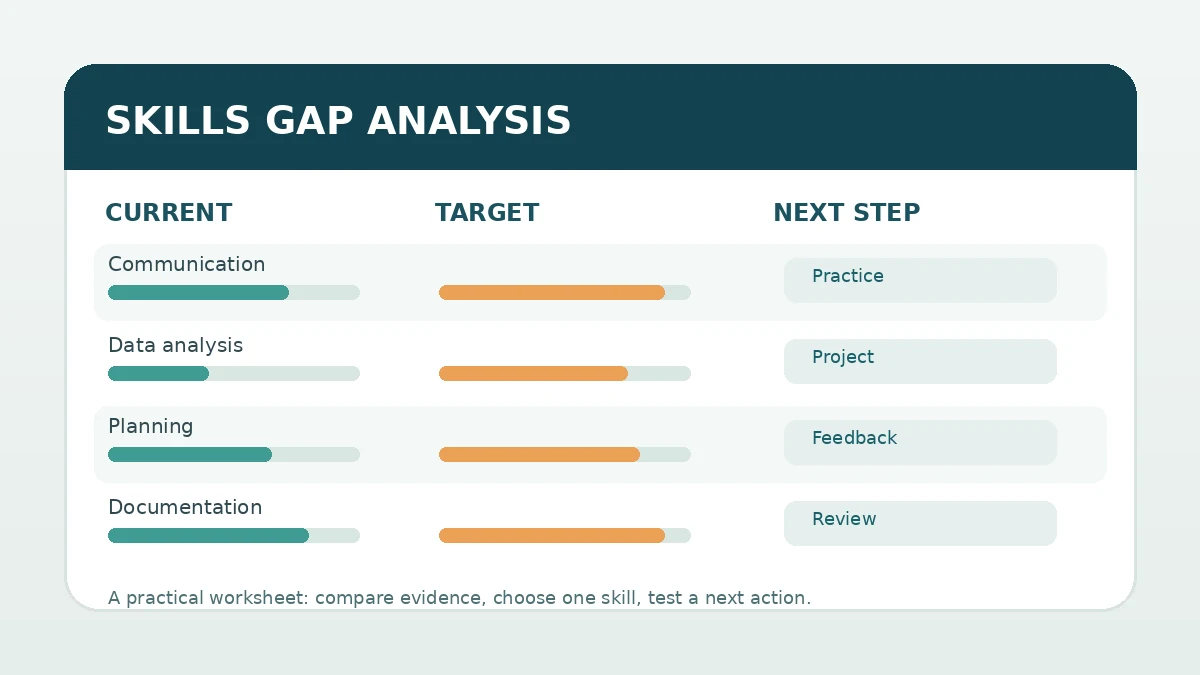
A career skills gap analysis compares what a target role actually requires with what you can demonstrate today. The result is not a judgment of your potential. It is a short, evidence-based list of capabilities to practice, prove or learn before applying for a role, asking for new responsibilities or choosing a course.
This guide provides a copyable skills gap analysis worksheet, a worked example, a prioritization method and a four-week learning plan. It is deliberately narrower than a full personal development plan: first you identify a specific skill difference; only then do you choose a realistic next action. No certificate, course or checklist can guarantee a job offer or promotion.
What counts as a skills gap?
A skills gap is a difference between the level of capability a task or role requires and the level a person can currently demonstrate. It may involve technical knowledge, communication, project coordination, regulatory qualifications or experience using a particular process. It is not the same as a personal flaw. Sometimes the gap is in the tools, instructions, staffing or opportunity to practice—not the worker.
The CIPD learning-needs guidance recommends identifying current and future capability requirements, collecting evidence and connecting development choices to real performance needs. It also warns against assuming every problem needs a training course. That principle matters for individuals too: define the work first, then decide what would help.
Step 1: Choose one target role or responsibility
Write the target precisely: “junior data analyst who builds weekly reports,” “team coordinator who runs client handoffs,” or “freelancer who prepares fixed-price estimates.” Avoid targets such as “be more successful.” If you are exploring a new occupation, compare several current job descriptions rather than treating one employer’s wishlist as a universal standard.
For U.S.-focused occupations, O*NET OnLine describes tasks, knowledge, skills and abilities for hundreds of occupations. The U.S. Department of Labor explains that O*NET draws on regularly updated occupational information. It is a research starting point, not an individualized assessment or a substitute for local licensing rules. If you work outside the U.S., check the applicable national occupational and credential requirements.
Step 2: List five to eight skills that matter
Read the tasks first, not only the job title. A role that mentions “data analysis” may require cleaning a spreadsheet, interpreting a chart, documenting assumptions and explaining a recommendation. Split broad labels into observable tasks. A useful list includes both the core work and the communication needed to deliver it.
- Core technical skills: the tools, methods or subject knowledge directly used in the work.
- Transferable skills: writing, problem solving, listening, prioritization and coordination that can be shown through examples.
- Role-specific requirements: credentials, safety procedures or regulatory knowledge that cannot be replaced by a personal project.
- Delivery skills: quality checks, handoffs, documentation and explaining trade-offs to others.
Avoid copying 30 generic “top skills” from a job listing into your worksheet. The goal is to create a small, defensible set that you can investigate and improve. If a requirement is vague, ask a hiring manager or experienced practitioner what a competent performance looks like.
Step 3: Rate evidence, not confidence
Use a simple 0–3 scale for both your current demonstrated level and the level the target task needs. These numbers are a personal planning rubric, not standardized occupational ratings. Your score should be tied to an example you could show or describe.
| Score | Working definition | Possible evidence |
|---|---|---|
| 0 — Not yet demonstrated | I have not performed this task in a realistic setting. | No relevant example or completed exercise. |
| 1 — Guided | I can complete basic steps with instructions or review. | A tutorial project with notes on where help was needed. |
| 2 — Independent | I can complete common cases and explain my decisions. | A work sample or project completed without step-by-step guidance. |
| 3 — Adaptable | I can handle exceptions, evaluate trade-offs and help others. | Multiple examples, documented judgment and feedback. |
For each skill, record an example: a cleaned dataset, a meeting recap, a client estimate, a documented troubleshooting process or a presentation. If you cannot provide evidence, mark the rating as uncertain and test it with a small task. A high self-rating without examples is less useful than an honest “not yet sure.”
Step 4: Build the skills gap worksheet
Use one row per skill. The “gap” is target level minus current demonstrated level. A gap of zero means the current evidence meets your chosen target; it does not mean you have mastered the entire field. Negative gaps can indicate strengths you already bring. The table below is a fictional example for a worker moving from operations support toward a reporting-focused coordinator role.
| Skill | Current / target | Gap | Evidence and next test |
|---|---|---|---|
| Spreadsheet cleaning | 1 / 2 | 1 | Clean a sample dataset and document five checks. |
| Writing concise summaries | 2 / 2 | 0 | Use an existing project recap as evidence. |
| Explaining charts | 1 / 3 | 2 | Present a short chart story and ask for critique. |
| Scheduling handoffs | 2 / 2 | 0 | Show a completed handoff with owners and dates. |
| Documenting assumptions | 0 / 2 | 2 | Write assumptions for a sample analysis. |
In this example, chart explanation and assumption documentation are the largest numerical gaps. But numbers alone do not decide priority. A mandatory safety credential, a deadline for a real project or a basic prerequisite may matter more than a high score in a less relevant skill. Use judgment and verify the target level with credible job evidence.
Step 5: Prioritize by importance, urgency and practice opportunity
A practical priority question is: “Which one gap is important for the target work, blocks another skill, and can be tested within four weeks?” Start with the task that offers the strongest combination of relevance and achievable practice. You do not need a complex weighted formula unless you are comparing many roles.
- Importance: Does the skill appear in core tasks or repeatedly across relevant job descriptions?
- Urgency: Is there an upcoming assignment, application or required qualification?
- Prerequisite: Does this skill unlock other work, such as basic spreadsheet cleaning before chart analysis?
- Opportunity: Can you practice on a safe, realistic project and get useful feedback?
- Cost: Can you use a free resource, internal mentoring or a small project before paying for training?
For example, a reporting coordinator might prioritize accurate data cleaning before presentation design. An attractive dashboard is not useful if the underlying figures are unreliable. Conversely, someone with strong analysis but unclear written summaries may get more benefit from practicing concise explanations than from another technical course.
Step 6: Choose learning that produces evidence
A course can be helpful when it teaches missing knowledge or a required credential. But watching videos alone does not demonstrate workplace competence. Choose an activity that ends with a visible artifact or observable performance: a completed spreadsheet, a documented process, a short presentation, a revised proposal or a supervised practice task.
The CIPD’s 2026 skills-matching guide includes skills audits, gap prioritization and different responses to a mismatch. The lesson for individual career planning is to distinguish training needs from job-design and opportunity needs. If you already know a method but never get to use it, seek an appropriate project or shadowing opportunity rather than buying the same course again.
A four-week skills gap action plan
| Week | Action | Evidence to keep |
|---|---|---|
| 1 — Verify | Confirm the target task, gather two role descriptions, and complete one baseline exercise. | Requirements list and initial work sample. |
| 2 — Learn | Study one missing concept and repeat the exercise with guidance. | Notes on errors and a revised sample. |
| 3 — Apply | Complete a realistic project or supervised task without step-by-step prompts. | Finished artifact with assumptions and quality checks. |
| 4 — Review | Ask a relevant person for one improvement and repeat the task. | Before/after sample and a short next-step decision. |
Do not claim a skill level increased merely because four weeks passed. Compare the second work sample with the first using the same criteria. If the task is still difficult, extend practice or choose a smaller prerequisite. If the work meets the target, document it in your portfolio or discuss it in a development conversation. For requesting actionable input, see how to ask for feedback at work.
Where to find credible career skill information
Start with actual work samples and multiple job descriptions. Then cross-check with structured occupation resources such as O*NET. The U.S. Department of Labor’s mySkills myFuture can help explore careers related to past work and compare transferable skills. These resources describe occupations and training options; they do not guarantee that a particular employer will accept your experience.
Ask whether a training provider is accredited when accreditation matters, whether a certificate is actually requested in the target role, and whether the program includes assessed practice. Compare total costs and time before committing. A free project and credible feedback may sometimes answer your question better than an expensive course.
Mistakes that make a skills audit misleading
- Starting with a course catalog: Begin with a real task and its required standard, not a product you hope will fix everything.
- Using only self-confidence: Anchor ratings to observable work samples and credible external examples.
- Ignoring existing strengths: Transferable skills can reduce the amount of new training needed.
- Overreacting to one listing: Check multiple employers and distinguish essentials from preferences.
- Confusing missing opportunity with missing skill: Sometimes you need access, coaching or a project, not more instruction.
- Assuming the audit is permanent: Roles, tools and requirements change; revisit the worksheet when your target changes.
Once the top gaps are clear, integrate them into a wider career plan. Our career growth mindset guide covers how to sustain learning through setbacks; this worksheet supplies the narrower evidence and prioritization step. You can also translate a priority into one measurable objective using personal development goals.
Frequently asked questions
What is a career skills gap analysis?
It is a structured comparison between the skills a specific role or task requires and the skills you can currently demonstrate. A useful analysis includes evidence, priorities and a plan to test improvement.
How many skills should I include?
Start with five to eight relevant skills for one target role. A small, well-evidenced list is easier to act on than dozens of generic competencies.
Can I use a skills gap analysis to change careers?
Yes, as an exploration tool. Compare transferable skills and new requirements using credible occupation sources, then check local credentials and real job listings. It does not guarantee a job match.
Do I need to buy a course to close every skills gap?
No. Depending on the gap, you may need guided practice, a real project, mentoring, access to tools or a required qualification. Choose the response that produces credible evidence of capability.