
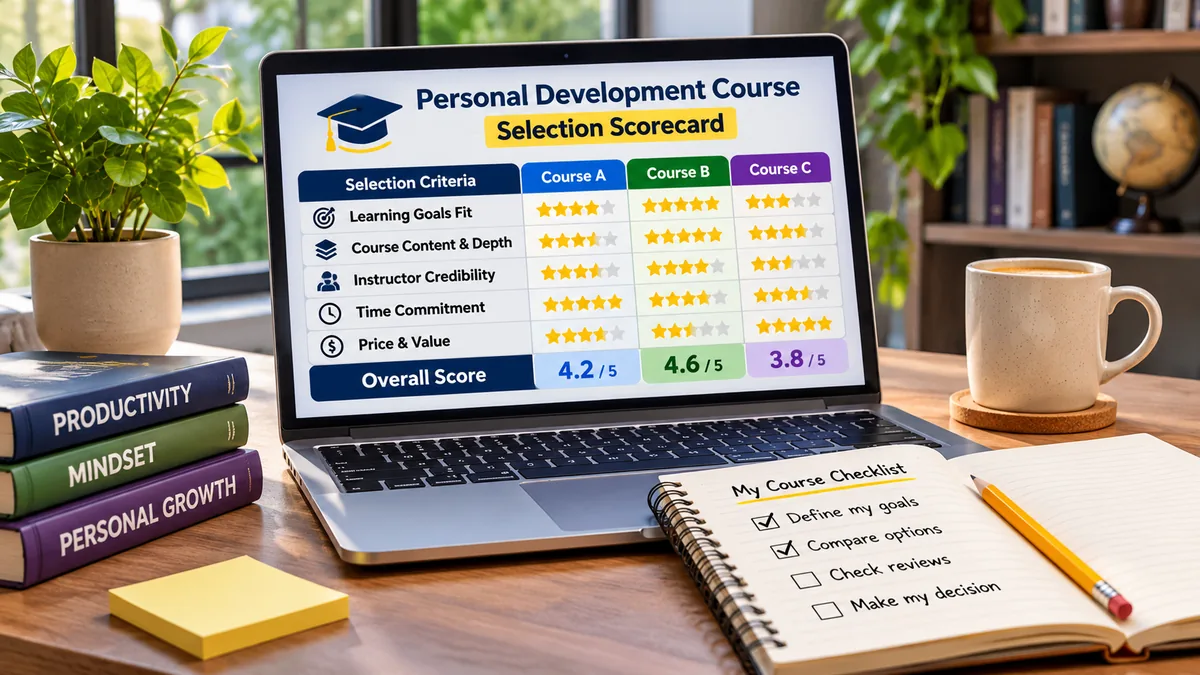
A list of popular online programs can give you ideas, but it cannot tell you which program deserves your time. This personal development course selection scorecard helps you compare courses against your real learning goal, available time, evidence of practice, instructor credibility and price. Instead of relying on a top-ten ranking, you make a decision you can explain and revisit.
Use the copyable spreadsheet layout below to compare up to several candidates on one consistent scale. The scores are your own judgments, not independent ratings of any provider. If you need suggestions for actual programs first, use our guide to personal development courses; that separate page compares seven named options. This page explains how to choose among them.
Key takeaways
- Define one observable skill you want to practice before browsing course catalogs.
- Use a weighted rubric rather than choosing solely by reviews, star ratings or advertising.
- Check the syllabus, assessment method, actual price and refund or cancellation terms on the provider website.
- A high score only helps if you can finish the program and apply what it teaches.
Table of Contents
Start with the outcome, not a course ranking
“I want to improve myself” is too broad to guide a useful course purchase. Define a result such as “I can lead a difficult project update without losing the agenda,” “I can complete a focused study session and recall key ideas,” or “I can present two alternative solutions to a complicated workplace problem.” These are observable outcomes you can practice.
Next, identify the missing capability. Is your obstacle lack of information, inconsistent practice, poor feedback or insufficient opportunity? If you know the technique but rarely use it, another lecture-heavy course may offer little value. A program with exercises, deadlines and peer feedback might be more appropriate.
Write a goal in this format: By [date], I will [observable action] in [specific setting], and I will measure progress by [evidence]. Example: “Within 30 days I will use structured agendas in four client calls and record whether decisions and owners were documented.” A useful course should make that action easier.
A five-factor course comparison rubric
Score each course from 1 (poor fit or unverified) to 5 (excellent fit with evidence). The rubric assigns the largest weight to matching your learning goal. You can adjust the weights in your own spreadsheet, but the sum should remain 100%. Do not give a course full points merely because its landing page makes confident promises.
| Criterion | Weight | What to examine |
|---|---|---|
| Learning-goal fit | 35% | Does the course teach the exact skill and level you need? |
| Practice and feedback | 25% | Are there exercises, assignments, worked examples or feedback? |
| Instructor and evidence | 20% | Can you verify instructor credentials, sources and teaching scope? |
| Time commitment | 10% | Does the schedule fit your available study blocks? |
| Value and terms | 10% | Is the complete price clear, including renewal and access? |
The 35/25/20/10/10 split is our editorial decision aid, not a scientific measurement of educational effectiveness. A course needed for a recognized professional credential may require more weight on accreditation and course prerequisites. A short practical workshop may deserve more weight on exercises and feedback.
If a criterion cannot be verified, mark the information missing rather than treating lack of evidence as proof that the course is poor. Build a shortlist of two or three courses and visit their official pages before scoring.
Worked example: compare three fictional courses
Imagine three fictional programs: A is a short self-paced video course, B is a longer practice-led course, and C is an inexpensive workshop. You rate the programs according to your specific goal; another learner could reasonably score them differently.
| Program | Goal | Practice | Evidence | Time | Value | Weighted score |
|---|---|---|---|---|---|---|
| Course A | 4 | 4 | 3 | 5 | 4 | 3.90 / 5 |
| Course B | 5 | 3 | 5 | 2 | 4 | 4.10 / 5 |
| Course C | 3 | 5 | 3 | 4 | 5 | 3.80 / 5 |
For Course B, the calculation is (5 × 0.35) + (3 × 0.25) + (5 × 0.20) + (2 × 0.10) + (4 × 0.10) = 4.10. The score makes the trade-offs transparent: it has the strongest goal match but the weakest time fit. Before choosing it, you should confirm whether you can complete the workload.
A weighted score is not an automatic purchasing recommendation. Your final decision can be a lower-scoring option if there is a compelling constraint such as accessibility, budget, scheduled cohort support or institutional requirements.
Build the editable course selection scorecard
Copyable spreadsheet template: create columns for Course Name, Goal Fit, Exercises, Credibility, Time Fit, Value, Weighted Score, Notes and Official Course Link. Add weights of 35%, 25%, 20%, 10% and 10% above the five scoring columns, then enter scores from 1 to 5. Replace the fictional examples in this article with courses you have actually researched.
In your spreadsheet, enter the course name and five numeric scores. The score column can use =SUMPRODUCT(B6:F6,$B$3:$F$3); the weights are stored in row 3. If you change the weights, make sure they still total 100%. Leave a note explaining each unusual score and include a link to the official course syllabus.
Save a dated copy of your comparison. Fees, access, subscriptions and course descriptions can change, and a score made six months ago should not silently be treated as current. A useful spreadsheet is a decision record, not a permanent ranking.
Verify syllabus, access and credentials
Before enrolling, open the official syllabus and check what the course actually teaches. “Improve communication skills” may mean watching an introductory lecture, writing mock responses, presenting in a group or receiving feedback from an instructor. Those experiences are not interchangeable.
Next check the instructor and provider: are names and qualifications visible, are claimed professional affiliations verifiable, and is the teaching material relevant to your goal? A prestigious logo is not a guarantee of usefulness, but transparent instructional responsibility is a positive signal.
Review the assessment method. A certificate awarded for watching videos demonstrates a different level of evidence than one based on graded assignments and observed work. For career-related learning, look for outputs you can show: a portfolio piece, a project, a presentation, or a documented new process.
Finally read the complete enrollment conditions. Does access expire? Is a subscription billed automatically? What happens if you pause? Are financial aid, audit options or institutional licenses available? Check these details on the actual provider page; advertisements and third-party summary pages can become outdated.
Free versus paid courses: the real trade-offs
Free courses can be excellent for exploration, especially when you are still defining a goal or testing whether the instructor’s approach fits you. A free audit may include lectures while excluding graded assignments, completion certificates or discussion access. Confirm the limitations before treating a course as “free.”
A paid program can be worth its cost when it adds structured feedback, a consistent cohort, specialist coaching or an independently valuable credential. Paying more is not evidence that content is better. Compare the exact features you need and estimate the total cost rather than the introductory price alone.
An example decision: if you need a basic introduction to problem-solving, a free course with practical exercises may be enough. If you need repeated feedback on real client presentations, a small cohort workshop could be more useful than dozens of extra recorded lessons. Neither path guarantees career advancement or income gains.
A seven-day test before making a commitment
You may not know if the teaching style is suitable until you test it. During the first week, try a sample lesson or published preview where available; read the assessment instructions; and complete one small exercise. Note how much time it actually takes compared with the advertised schedule.
- Day 1: write the learning outcome and choose your scorecard criteria.
- Day 2: collect official syllabi and access terms for three candidates.
- Day 3: check instructor, format, practice tasks and total price.
- Day 4: score each candidate and document missing evidence.
- Day 5: try a sample lesson or a comparable free exercise.
- Day 6: identify one outcome you can measure after completion.
- Day 7: choose, defer or reject based on the evidence—not pressure.
If your calendar cannot accommodate the course, you can make a deliberate “not now” decision. Choosing when to learn is as important as choosing what to learn.
Common course-selection mistakes
- Choosing by ranking alone: a top course on someone else’s list may miss your goal.
- Counting certificates as skills: evidence of application matters more than collecting badges.
- Ignoring prerequisites: check whether the starting level assumes knowledge you lack.
- Overlooking the full price: verify subscriptions, exams, refunds and access limits.
- Buying before checking availability: course pages and instructors may change.
- Ignoring accessibility: check captions, transcripts, time-zone needs and device compatibility.
- Overweighting testimonials: examples of satisfaction cannot establish your own result.
If a course claims it will guarantee promotion, employment or a specific income, treat that as a reason to demand credible evidence and read the conditions carefully. Professional development is influenced by your circumstances and opportunities as well as training quality.
Turn your choice into a 30-day learning plan
After you choose, translate the program into a small learning plan. Set a recurring study block, decide which exercises matter most, and pick a real context in which you will use the skill. For example, someone learning assertive communication could practice one structured conversation each week and record which parts felt clear or difficult.
At the end of 30 days, ask: what can I demonstrate now that I could not do before? What evidence do I have completed work, decisions, a presentation or feedback? Was the time cost sustainable? Use those observations when selecting the next program.
For a wider skills baseline, try our career skills gap analysis worksheet; it helps identify the capability worth building before you shop for training. For named course recommendations, return to the personal development courses guide. Together, the three pages answer distinct questions: what skill do I need, how do I evaluate programs, and which current offerings might fit?
Frequently Asked Questions
How do I choose a personal development course?
Start with a measurable learning goal, compare actual syllabi and practice tasks, check instructor credibility and complete pricing, then choose a program you can realistically finish.
What is a course selection scorecard?
It is a worksheet that scores potential courses against consistent criteria such as learning-goal fit, exercises, credibility, time and cost. The score supports a decision; it is not an independent product rating.
Should I pay for a course or take a free one?
Choose based on the learning experience and your needs. A free option may be sufficient for exploration; paid feedback or credential evaluation may matter for a specific career goal.
Does a certificate prove I learned a skill?
A certificate may document completion or assessment, depending on the provider. The best evidence is a demonstrated ability to apply the skill in a relevant context.
Can I edit the weights in the spreadsheet?
Yes. The spreadsheet you build from the layout above allows you to adjust the weights for the five comparison criteria. Keep their total at 100% to preserve the intended 1–5 weighted scoring scale.