
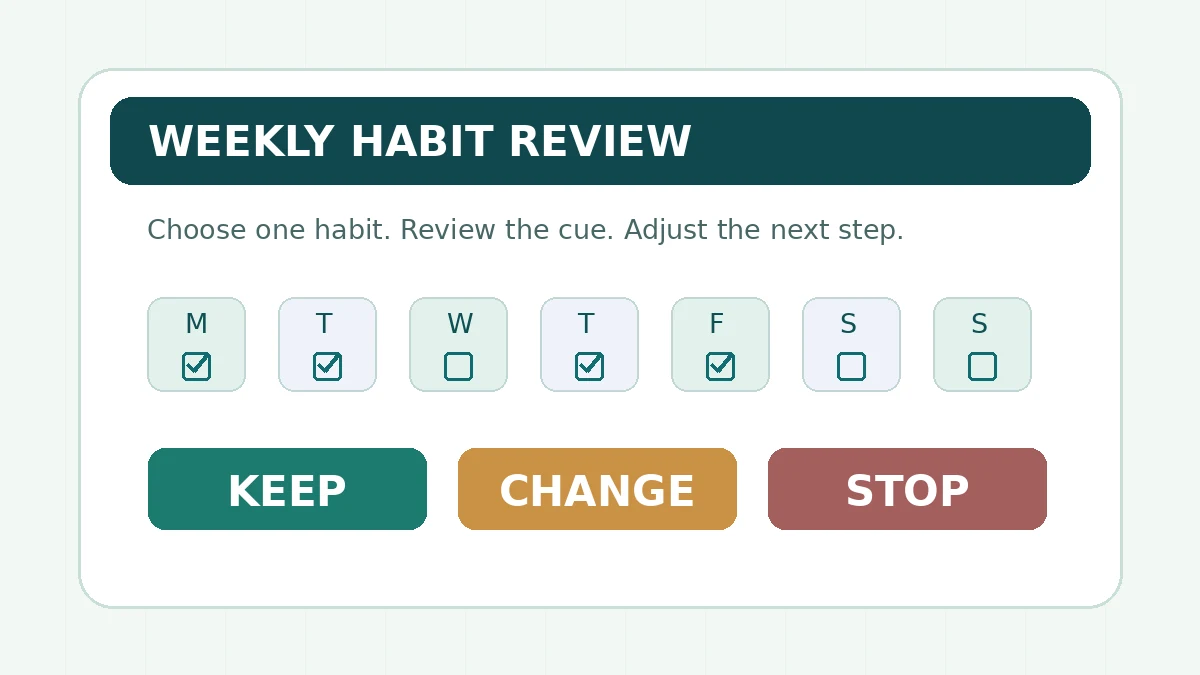
A habit tracker can tell you whether you checked a box. It rarely tells you why a useful routine worked on Tuesday but disappeared on Thursday. A weekly habit review template adds the missing conversation: Which cue helped? What got in the way? Should you keep the routine, change its design, or stop doing it altogether? The aim is a better system for real life, not an unbroken streak or a claim that productive people never miss a day.
Below is a copyable five-question worksheet, a fictional worked example, and a fifteen-minute review process. The approach is narrower than a general guide to self-discipline at work: it focuses on diagnosing one specific routine after you have tried it, rather than collecting motivational rules. You can use it for work, study or everyday administrative habits.
What to review—and what not to measure
A habit is a behavior that becomes easier to repeat when a familiar context cues it. That is different from an ambitious goal such as “be successful” or “grow my business.” For a weekly review, choose something observable: “After my first coffee, I write the three deliverables for today” or “Before I close the laptop, I note the next action for the open task.” These can be tested without making judgments about your character.
Research by Lally and colleagues on habit formation followed volunteers practicing simple behaviors in repeated contexts. The study found substantial variation in how quickly automaticity developed and that missing one opportunity did not materially undo the process. It does not establish a universal 21-day or 66-day rule for every complex workplace routine. Use a weekly review to adapt conditions, not to decide that one missed day proves failure.
The five-question weekly habit review worksheet
- 1. Behavior: What exact action did I intend to repeat? Write one observable sentence.
- 2. Cue: What event, place or time was supposed to trigger it? Did that cue occur reliably?
- 3. Evidence: On which occasions did I actually do it? Use approximate notes rather than reconstructing a perfect streak.
- 4. Friction: What made the action easy or difficult? Consider time, tools, interruptions, unclear ownership and workload.
- 5. Decision: Keep, change or stop? Write one adjustment and the next date you will review it.
The fifth question is the most important. A review without a decision can become a ritual of self-criticism. “Change the cue from 8 a.m. to after the daily stand-up” is actionable. “Be more disciplined” is not. If the behavior serves no meaningful goal, stopping it may be the best outcome.
A worked example: the two-minute end-of-task note
Imagine a project coordinator who wants to leave a two-minute note when pausing an unfinished assignment. The note records the next action, a file location and one open question. The goal is easier resumption after interruptions, not completing more work in fewer hours. This is a fictional example; your work may require a different format.
| Review question | Example answer |
|---|---|
| Behavior | Write a next-action note before switching away from a complex task. |
| Cue | The moment a scheduled meeting starts or an urgent request interrupts. |
| Evidence | Completed on Monday, Tuesday and Friday; missed on Wednesday and Thursday. |
| Friction | Unexpected calls left no obvious place to capture a note. |
| Decision | Change: keep a pinned note template and use a 20-second version for interruptions. |
The worker does not need to conclude that a three-out-of-five week was a failure. The pattern suggests that the cue is inconsistent and the action may be too elaborate during unexpected calls. A smaller version might be more sustainable. The interruption recovery guide offers a complementary resume plan for exactly this kind of task.
The fifteen-minute Keep–Change–Stop review
Minutes 1–3: Describe the behavior, not your personality
Write what you attempted and when. Avoid labels such as “I am lazy” or “I am a winner.” A useful description is “I intended to spend ten minutes preparing tomorrow’s task list after closing email.” The wording should be specific enough that another person could tell whether the behavior happened.
Minutes 4–6: Look for the cue
Ask what usually happened immediately before the behavior. Was the cue stable, or did it depend on a meeting that was frequently canceled? If the cue was missing, a more forceful reminder may not solve the problem. Try anchoring the behavior to a reliably occurring event. An if-then planning worksheet can help specify a trigger and response.
Minutes 7–9: Identify one source of friction
Friction can be practical rather than psychological: a slow application, unclear instructions, a shared workspace, a missing template, unpredictable care duties or a manager changing priorities. Write down one constraint you could reduce and one that requires help or acceptance. Do not blame an individual for an environment they do not control.
Minutes 10–12: Choose keep, change or stop
- Keep: The behavior is useful, feasible and repeats under ordinary conditions. Preserve its cue and avoid unnecessary complexity.
- Change: The goal is still useful, but the cue, size, location, timing or support needs adjustment. Change only one element for the next test.
- Stop: The behavior is no longer relevant, conflicts with a higher priority, or creates more cost than benefit. Document the reason so it does not quietly return as an obligation.
Minutes 13–15: Set a small next test
Write the next cue and action in one sentence, then schedule a review. For example: “After the Friday client handoff, I will record three open issues in the shared tracker.” If the task is optional, decide whether it deserves another week at all. The review should reduce planning overhead, not become another large project.
A copyable seven-day tracking table
Use a compact record with room for context. Do not turn the table into a moral scorecard. A missed opportunity because of a holiday or illness is different from a routine that repeatedly fails in ordinary conditions. Mark “not applicable” when the cue did not occur.
| Day | Cue happened? | Action done? | One observation |
|---|---|---|---|
| Monday | Yes | Yes | Template was already open. |
| Tuesday | Yes | Yes | Used the same cue. |
| Wednesday | No | N/A | Schedule changed. |
| Thursday | Yes | No | Unexpected meeting; no quick version. |
| Friday | Yes | Yes | Short version worked. |
| Saturday | No | N/A | Non-working day. |
| Sunday | No | N/A | Non-working day. |
The example does not calculate a “success percentage” because different contexts can make such a number misleading. You can count opportunities if that helps, but the decision should depend on usefulness and friction, not only a streak. If a habit involves health, safety or mandatory compliance, use the relevant professional standard rather than treating the action as an optional personal experiment.
How to tell a useful habit from busywork
A useful habit supports an outcome you actually value: fewer missed handoffs, clearer decisions, reliable follow-up, or less duplicated effort. It should be possible to explain the benefit without resorting to “successful people do this.” Some routines look impressive but add little value. For example, a complicated morning dashboard may consume more time than the simple list of priorities it replaces.
Ask: “If I stopped this for a month, what would become harder?” If the answer is unclear, consider a trial pause. Conversely, a small routine that prevents recurring mistakes may be worth keeping even if it is not exciting. For a broader planning framework, compare the routine with your personal development plan and make sure it serves a defined goal.
What if the problem is workload, not habit strength?
Not every missed routine is a personal behavior problem. If deadlines collide, interruptions are constant or work expands without clear ownership, the solution may require team-level changes. The World Health Organization identifies excessive workload and low control among workplace risks. It is not responsible to advise people to overcome structural overload by adding more habits.
A better next action might be to ask a manager which deliverable takes priority, improve a shared handoff process or reduce unnecessary meetings. The workplace boundaries scripts can help make those trade-offs explicit. If the issue is a formal safety or legal requirement, follow the proper process rather than a personal tracker.
Common mistakes in weekly habit reviews
- Reviewing too many habits: Start with one behavior; several simultaneous experiments make causes hard to interpret.
- Changing everything at once: Adjust one cue or friction point so you can learn from the next week.
- Confusing intention with evidence: “I wanted to” is useful context, not the same as “I did.”
- Punishing a missed day: Record the reason and return to the next relevant cue.
- Tracking without deciding: End each review with keep, change or stop, and a clear next test.
The purpose is learning. A habit that survives because it is simple, useful and supported by the environment is more valuable than a long list maintained by guilt. Some routines take weeks or months to feel automatic; there is no fixed timetable for every person or task.
Frequently asked questions
How long should a weekly habit review take?
About 10–15 minutes is enough for one routine. The exact duration is not a scientific threshold; keep the review short enough that it helps rather than becoming another obligation.
Should I track a habit every day?
Only if daily tracking adds useful information. For a weekly behavior, track relevant opportunities. Mark days when the cue did not occur as not applicable instead of counting them as failures.
Does missing one day ruin a habit?
No universal rule says that. Research on simple repeated behaviors found that one missed opportunity did not materially undo habit formation. The context and type of behavior still matter.
What if I keep changing the habit every week?
That may indicate the goal is unclear or the environment is unstable. Pause to define the actual outcome and choose one manageable change. If the routine is not useful, stopping is a legitimate decision.
Your next review
Pick one small routine you tried this week. Record its cue, the actual opportunities, the main friction and a keep–change–stop decision. The goal is not to become a “winner” by checking boxes; it is to build a realistic process that makes meaningful work easier to repeat.