
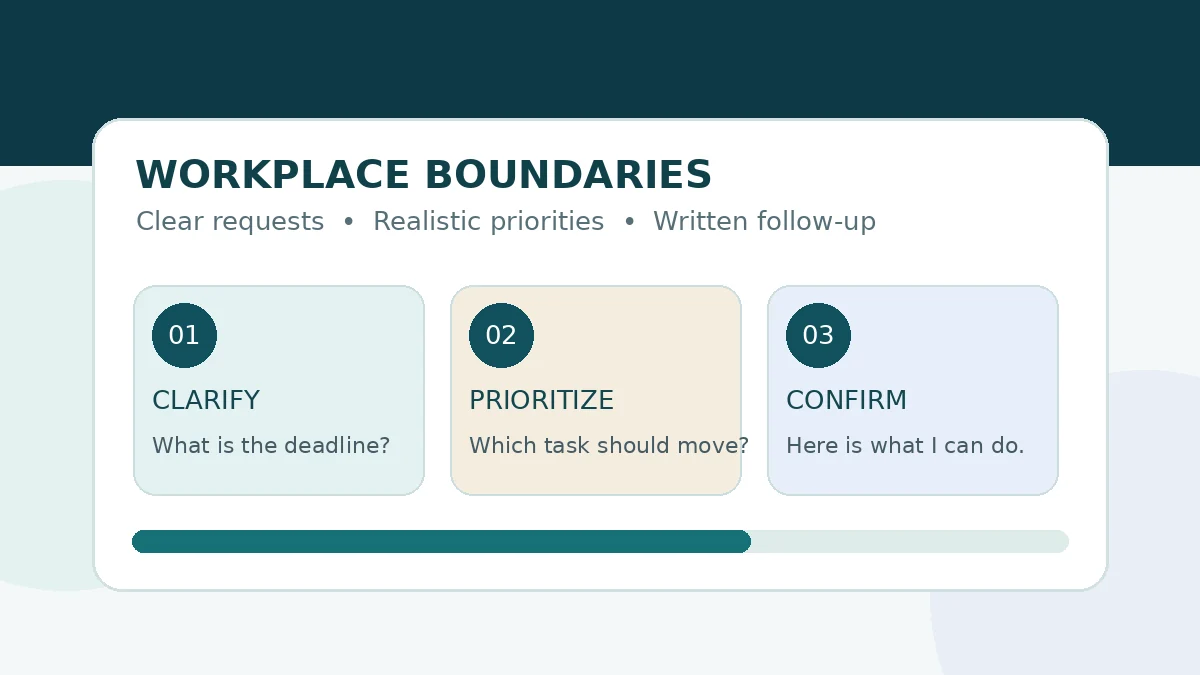
When someone asks for “one quick thing” during an already full day, the difficult part is rarely finding a polite word for no. It is deciding what can realistically be done, what should change, and how to communicate that without creating unnecessary conflict. Learning how to set boundaries at work means making expectations, availability and priorities explicit—not refusing teamwork or pretending that every employee has equal power to decline work.
This guide provides nine copyable scripts, a workload-priority worksheet, and a simple follow-up method. It focuses on everyday office and remote-work situations. It does not replace your employment contract, workplace policies, applicable law, union advice or a formal accommodation process. If the issue is harassment, discrimination, safety or retaliation, a polite script alone may be insufficient.
A boundary is a clear work agreement, not a personal ultimatum
A useful workplace boundary answers three questions: What is being requested? What capacity or constraint exists? What is the next workable option? “I never help after lunch” is an absolute rule that may not fit a team. “I am finishing the client report until 3 p.m.; I can review this after that or we can reprioritize” communicates the real trade-off. You can be cooperative without promising two incompatible deadlines.
Boundaries are partly an organizational responsibility. The World Health Organization identifies excessive workloads, low job control and limited support as workplace risks, and recommends organizational measures rather than relying only on individual coping. The CIPD manager guide on stress similarly emphasizes spotting and addressing workload problems. Personal scripts can help reveal a problem; they cannot fix chronic understaffing on their own.
Before you answer, run a 30-second priority check
- Scope: What deliverable is actually needed? Is this a two-minute answer or a new project?
- Deadline: Is the time truly fixed, or merely assumed?
- Ownership: Who has authority to change the priority or approve extra hours?
- Impact: What existing task, customer commitment or safety check would be displaced?
- Options: Can you offer a later slot, a smaller first step, a handoff or a trade-off?
If a request is urgent because of a real safety incident, service outage or contractual duty, follow the relevant escalation procedure. Do not use a generic “not my problem” script where immediate action is required. In ordinary priority conflicts, clarify the trade-off before committing.
Nine boundary-setting scripts for common situations
1. A manager adds a task to a full workload
Try: “I can take this on. I am currently finishing A by Thursday and B by Friday. Which should move so I can give this the attention it needs?” This frames capacity as a planning decision, not an emotional argument. If the manager says all three are urgent, ask what minimum viable outcome or support would make the schedule realistic.
2. A colleague asks for help during focus time
Try: “I am in the middle of a deadline-sensitive task. Can I give you 15 minutes at 2:30, or is there a blocker that cannot wait?” This distinguishes an interruption from an emergency. For a concrete recovery method after interruptions, see the four-step task-resumption plan.
3. Someone wants an instant reply outside agreed hours
Try: “I review messages during my working hours and will respond tomorrow morning. For genuine urgent issues, please use the team’s on-call channel.” This works only if it matches your actual role and coverage arrangements. If your contract includes on-call duty, use the agreed procedure and discuss unclear expectations with your manager.
4. A meeting has no purpose or preparation
Try: “Could you send the decision we need to make and the materials beforehand? If this is just a status update, I can send my notes asynchronously.” If the meeting is essential, ask for a defined outcome and a realistic time box. A focused meeting agenda template can reduce ambiguity.
5. A coworker repeatedly transfers their responsibilities
Try: “I can show you the process this time, but I cannot own the recurring task. Let us document the handoff and confirm who is responsible going forward.” Avoid accusations about laziness; describe the repeated request, your role and the next ownership decision.
6. A customer expands the agreed scope
Try: “That feature is outside the approved deliverables. I can estimate its cost and timeline, or we can swap it for an existing item.” Freelancers and client-facing teams should document scope changes rather than quietly absorbing extra work. The scope-creep prevention guide provides a more detailed client-specific process.
7. You are asked to promise an unrealistic deadline
Try: “With the current information, I can deliver a checked draft by Wednesday. A final version by Monday would require dropping the review step. Which risk or scope change is acceptable?” Do not trade away safety, legal or quality-critical checks simply to sound accommodating. If the deadline is non-negotiable, escalate the capacity gap.
8. Feedback arrives in an unhelpful tone
Try: “I want to improve the work. Could we focus on the specific change needed and an example of the expected standard?” This does not excuse harassment or bullying. For ordinary critique, specific feedback questions and scripts can keep the conversation actionable. For abusive behavior, document the incident and use appropriate support channels.
9. You need to decline an optional commitment
Try: “Thank you for considering me. I cannot commit to the committee this month without affecting my core responsibilities. Please ask me again next quarter if the timing changes.” You do not need to provide a personal-life explanation for every optional request. A brief, truthful reason and a clear answer are often enough.
The capacity worksheet: make trade-offs visible
When “I am busy” fails to explain a conflict, use a simple table. List only the commitments relevant to the request. Include dependencies and the person who can approve a change. The example below is fictional; adapt it to your role and the actual priority process.
| Current commitment | Deadline / impact | Proposed adjustment |
|---|---|---|
| Client report | Thursday; requires quality check | Keep deadline; protect two review hours. |
| Team presentation | Friday; draft already started | Move to Monday if manager approves. |
| New data request | Requested for Thursday; scope unclear | Clarify minimum output and owner today. |
| Unexpected support issue | Potential customer impact | Use escalation route if truly urgent. |
Send a concise follow-up: “As agreed, I will deliver the report Thursday, move the presentation to Monday, and send a first-pass data summary Friday. Please tell me if the priorities change.” Written confirmation prevents later disagreement about what was actually promised. It is also useful when multiple people assign work independently.
What to do when the other person says no to your boundary
A request can be reasonable even when it is not accepted. Ask for the business reason, the revised priority and the support available. A manager may have information you do not. You may also have constraints they do not see. The goal is an explicit decision, not winning a debate. If the outcome creates an ongoing overload, record the pattern and raise it through your organization’s workload or health-and-safety process.
If you are requesting a formal change in hours, location or work pattern, distinguish that from an informal boundary conversation. Rules vary by country and employment status. For example, Acas provides a specific UK statutory flexible-working request procedure; it is not a universal rule for all readers. Check the current rules and your employer’s policy in your own jurisdiction.
A simple three-part message you can adapt
1. Acknowledge: “I understand the outcome matters.” 2. Name the constraint: “I have two fixed deliverables and limited review capacity.” 3. Offer a decision: “I can start this Friday, reduce the scope, or switch priorities with approval.” This pattern avoids both passive agreement and unnecessary confrontation. If the other person is a peer rather than your manager, involve the actual decision-maker when priorities conflict.
Practice with low-stakes requests before a high-stakes disagreement. You can combine the message with an if-then plan: “If I receive a new task while two deadlines are active, then I will ask which existing task moves before promising a date.” That converts a vague intention into a specific response.
Avoid four common boundary mistakes
- Overexplaining: A long apology can obscure the actual decision. State the constraint and option clearly.
- Making an empty threat: Do not announce consequences you cannot or should not carry out. Use the correct escalation route.
- Calling every request unreasonable: Some duties and emergencies are legitimate. Clarify facts before deciding.
- Assuming individual willpower fixes structural overload: Chronic understaffing, harassment and unsafe demands require management action and possibly outside support.
The most useful measure is not whether you said no. It is whether the team now understands what will be delivered, by whom, by when, and with what trade-offs. Healthy boundaries support reliable work; they should not be treated as a shortcut around accountability.
Frequently asked questions
How do I set boundaries at work without sounding rude?
Use neutral facts about capacity, deadlines and options. Acknowledge the request, state what you can realistically deliver and ask for a priority decision when needed. Tone matters, but clarity matters more than a long apology.
Can I refuse work assigned by my manager?
That depends on your role, contract, policies and applicable law. Do not assume every task is optional. You can clarify competing deadlines, safety issues and available support, and use formal channels for serious concerns.
What if my workplace expects replies after hours?
Check the agreed working arrangement, any on-call coverage and local rules. Ask for a written definition of genuine emergencies and response expectations. A personal preference alone may not override contractual duties.
When should I escalate a boundary problem?
Escalate when there is a safety or legal risk, repeated unmanageable workload, harassment, discrimination, retaliation or unresolved conflict about responsibilities. Keep factual records and use appropriate organizational or professional support.
A practical next step
Choose one recurring request that causes confusion. Write a two-sentence response using the acknowledge–constraint–option pattern. Then confirm the agreed priority in writing. A boundary that produces a realistic plan is more useful than a perfect phrase that changes nothing.
0 thoughts on “How to Set Boundaries at Work: 9 Polite Scripts”