
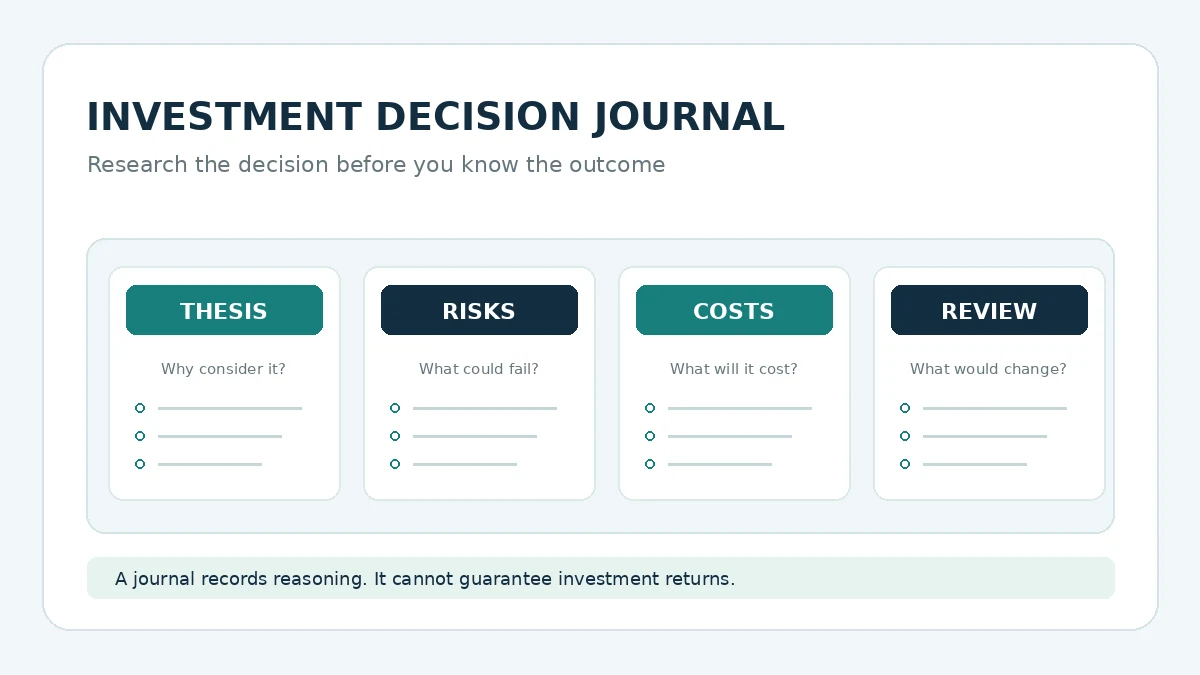
An investment decision journal template helps you document why you are considering an investment before the outcome is known. It cannot predict returns, and it should not turn investing into a daily trading game. Its value is simpler: it separates the original reason for a decision from the story you might tell yourself afterward.
This guide provides a copyable worksheet for researching a stock, fund or other investment, plus examples of how to review the decision without confusing a profitable outcome with a sound process. It is educational, not a recommendation to buy, sell or hold any security. Investing involves risk, including loss of principal.
Investment decision journal template: copy these 12 fields
Use a private document or spreadsheet with one row or page per decision. Keep personal identifiers and account numbers out of the journal. If you work with an adviser, the journal can help you prepare better questions rather than replace professional advice.
| Field | What to record |
|---|---|
| 1. Decision date | When you made the assessment, not when you first heard the idea. |
| 2. Investment or strategy | Name, type and relevant share class or fund identifier. |
| 3. Goal and time horizon | What financial objective this would serve and when funds may be needed. |
| 4. Evidence sources | Prospectus, filings, fee schedule and other independent documents. |
| 5. Investment thesis | Two or three testable reasons, stated without hype. |
| 6. Main risks | Ways the decision could lose money or fail the objective. |
| 7. Fees and taxes | Known costs and questions requiring professional review. |
| 8. Portfolio fit | Concentration, overlap and effect on your total allocation. |
| 9. Alternatives | At least one reasonable alternative, including doing nothing. |
| 10. Decision rule | Conditions under which you would proceed, wait or decline. |
| 11. Review trigger | A date or material change that would justify reassessment. |
| 12. Later reflection | What was known at the time and what changed afterward. |
Do not fill every field with a paragraph. A useful journal entry can be one page if the sources are linked and the assumptions are clear. The SEC’s investor protection guidance emphasizes independent research, checking investment professionals and understanding fees.
Start with the goal, not the investment headline
“This company is trending” is not a financial objective. A clearer statement might be “I am evaluating whether this investment would fit the long-term growth portion of my diversified portfolio, without increasing a sector beyond my stated limit.” If you do not have an allocation policy, begin there before researching a particular security.
Your journal should state when you may need the money and what losses you could tolerate financially and emotionally. Someone saving for an imminent expense may need a different approach from someone investing for a distant goal. A written goal is a useful filter for promotional claims.
Record evidence you can verify
List the exact sources you consulted and the date of each. For public companies, that may include financial statements and disclosures on the SEC’s EDGAR system. For funds, read the current prospectus, holdings and fee table. For an investment professional, check registration and disciplinary information using official databases. The SEC’s research-before-investing page explains why public disclosures matter.
Separate primary evidence from opinion. A social-media post may tell you which question to investigate, but it is not a substitute for a filing or prospectus. If you cannot locate current independent information, write “not verified” instead of filling the gap with confidence.
Write a thesis that could be wrong
A useful thesis contains a reason, a condition and a possible disconfirming fact. For a fictional diversified fund, a thesis might be: “This fund appears to provide broad exposure at a cost I understand, provided its holdings do not duplicate too much of my existing portfolio.” A disconfirming fact would be discovering substantial overlap or unexpected costs.
For a fictional individual stock, the thesis might depend on a business model, financial resilience and valuation assumptions. State what evidence would change your mind. Avoid phrases such as “can’t lose,” “guaranteed winner,” or “everyone knows.” Those are not testable claims.
Document risk before imagining returns
Ask what could go wrong, how much exposure the investment would add, and whether a loss could affect essential spending. Consider market risk, concentration, liquidity, currency exposure, leverage, counterparty risk and product complexity where relevant. A fund holding many securities can still be concentrated in one sector or market.
The SEC’s anti-fraud guidance warns against high-return promises with little risk and urges investors to research independently. If a pitch creates pressure to act immediately, record that as a warning sign rather than a reason to hurry.
Check the full cost of ownership
Write down the expense ratio for funds, any advisory or account fees, transaction costs and other product charges. Include potential tax consequences as a question to resolve, not a guess. The SEC’s updated fee bulletin explains how recurring fees can affect long-term outcomes and where to find disclosures.
A low headline fee does not necessarily mean an investment is the best choice. Costs should be considered alongside diversification, risk, liquidity, service and suitability for the goal. If you cannot explain the fees in plain language, the journal should say more research is needed.
Compare the decision with doing nothing
Every investment choice has an opportunity cost. Before acting, compare the proposed change with your existing allocation, a broader alternative and the option to wait. A new purchase may add complexity without improving diversification. The best decision may be to gather information or maintain your current plan.
For funds with narrow exposure, our niche index fund checklist offers a concentration and fee worksheet. For retirement accounts, see the retirement portfolio review checklist. These resources help with different parts of the research process; none can eliminate market risk.
Example: a fictional ETF journal entry
Date: October 31, 2026. Idea: consider a hypothetical international equity ETF for the long-term allocation. Goal: improve geographic diversification. Evidence: latest prospectus and holdings list, fee table and portfolio summary. Risks: currency volatility, country concentration, liquidity and overlap with existing global funds. Alternative: keep the current broad fund. Decision: no purchase until overlap and account-level costs are checked. Review trigger: when the missing disclosures are available.
This example is fictional and intentionally does not include a ticker, target price or expected return. It demonstrates a research process, not a trade recommendation.
How to review a decision without hindsight bias
At a later date, compare the outcome with what you knew at the time. A good process can lead to a loss, and a poor process can produce a gain. Record whether the original evidence was sound, whether the risks were recognized, and whether the decision fit your stated goals. Do not rewrite the original thesis after seeing the result. Keep the initial entry unchanged and add a dated follow-up.
Review triggers should reflect the investment and strategy. Examples include a major change in your financial goal, a material disclosure, a fee change or a portfolio allocation moving outside a predefined range. A daily price movement does not automatically require a decision. If you want a more general habit system, see financial independence habits.
Five journal mistakes to avoid
First, do not use the journal to justify a decision you already made. Second, do not record only winning trades or only the ideas that worked. Third, do not confuse an elaborate spreadsheet with independent research. Fourth, do not include private credentials or full account details. Fifth, do not treat the journal as proof that your forecasts are accurate. It is a record of reasoning, not a crystal ball.
One-page investment decision journal checklist
- State the goal and time horizon.
- List primary sources and dates.
- Describe the thesis and evidence that would challenge it.
- Identify risks, fees and possible tax questions.
- Check concentration and portfolio overlap.
- Compare at least one alternative, including no action.
- Write the decision rule and review trigger.
- Preserve the original entry for a later process review.
Bottom line: a journal cannot make investing risk-free. It can help you slow down, identify missing information and make your reasoning auditable to your future self.
Frequently asked questions
Do I need an investment journal if I only buy broad funds?
A short entry may still help you record your goals, allocation and fee assumptions. It does not need to be a trading log. If your strategy is simple and long-term, a periodic review note may be enough.
Should I record expected returns or price targets?
You may record assumptions if you can explain their basis, but do not treat a forecast as a promise. It is often more useful to document risks, costs, time horizon and conditions that would change the decision.
Does a profitable outcome prove I made a good investment decision?
No. Outcomes are affected by uncertainty and luck. Review whether the process used reliable information, respected your risk limits and fit your goals, regardless of the later result.