
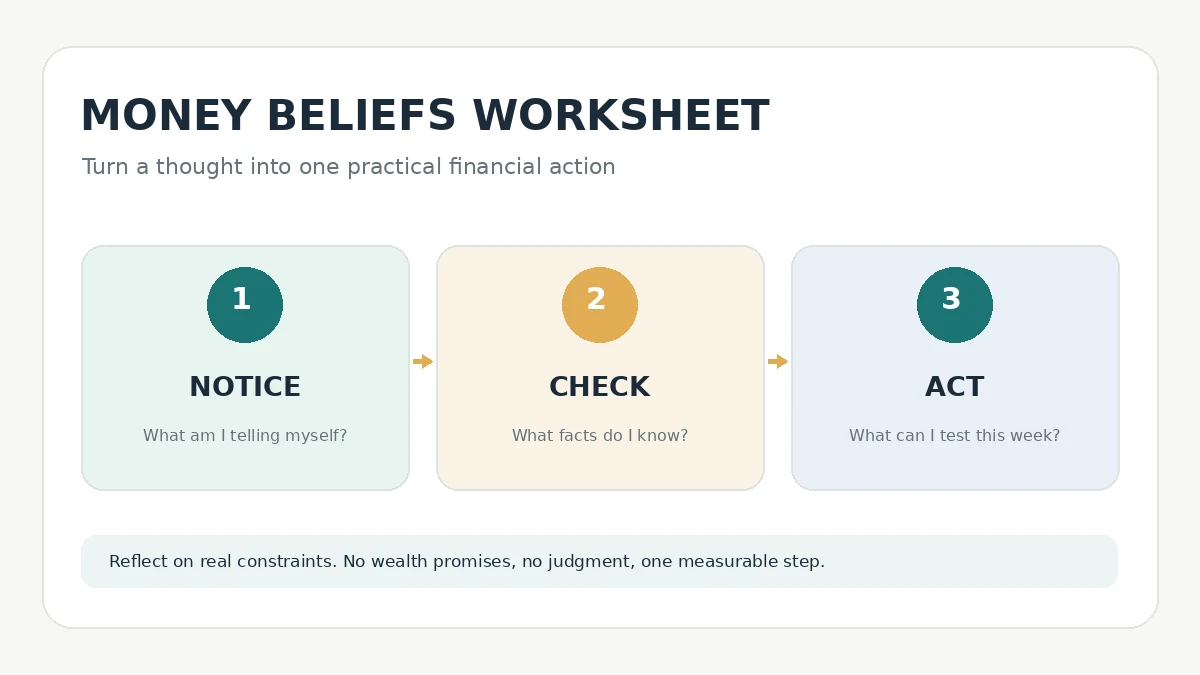
A money beliefs worksheet can help you notice the assumptions that shape everyday spending, saving and financial conversations. Some beliefs are useful: “I check the total cost before signing a contract.” Others can create avoidable problems: “If I cannot save a large amount, there is no point saving at all.” The goal is not to think positively until money appears. It is to connect a belief to a real decision and test a more practical response.
This guide provides ten reflection questions, a simple belief-to-action table and a seven-day experiment. It is an educational exercise, not a mental-health assessment or financial plan. Income, debt, caregiving responsibilities and structural constraints matter. A change in attitude cannot replace adequate resources or professional advice when you need it.
Money beliefs worksheet: 10 questions to answer
Set aside 15 minutes and use a private notebook. You do not need to share account balances, debt totals or family details with anyone. Write a short answer to each question, then circle one response you can act on this week.
- What did I hear about money most often when I was growing up?
- Which money decision makes me hesitate, and what do I fear might happen?
- When do I spend to reduce stress, reward myself or fit in?
- Which expense reliably improves my life, and which one rarely does?
- What does “enough” mean for my next three months?
- Do I avoid checking bills because I expect bad news?
- How do I respond when a friend or family member asks for financial help?
- What assumption do I make about people with more or less money than me?
- Which financial habit has worked even during a difficult month?
- What is one small, measurable action I can take within seven days?
There is no score or ideal personality type. The value comes from observing how a belief affects behavior. The Consumer Financial Protection Bureau’s money motivations resources discuss how relationships, goals and financial circumstances influence money choices. They offer tools for exploring these factors without reducing financial outcomes to willpower alone.
Separate a money story from a money fact
A money story is an interpretation such as “I am terrible with money.” A fact is something you can check, such as “I missed two bill due dates last month.” The story can feel permanent, while the fact suggests a specific fix: calendar reminders, a payment schedule or a conversation with the provider. Replacing a harsh label with an observable description makes it easier to choose a next step.
Try this sentence: “When [situation] happens, I tell myself [belief], so I tend to [action]. A more useful response would be [specific behavior].” For example, “When an unexpected expense arrives, I tell myself my budget has failed, so I stop tracking. A better response is to update the budget and identify which bill needs attention first.” This does not make the expense disappear, but it supports a clearer decision.
Belief-to-action table: five common patterns
| Unhelpful assumption | Reality check | Practical experiment |
|---|---|---|
| “Small savings do not count.” | Small amounts cannot solve every shortfall, but a repeatable habit can still be useful. | Choose an affordable amount and track it for four pay periods. |
| “Everyone else can afford this.” | Visible purchases reveal little about debt, income or priorities. | Compare the purchase with your own next-month obligations. |
| “I must never spend on enjoyment.” | A sustainable plan can include reasonable discretionary choices. | Set a modest category that does not compromise essentials. |
| “If I ask about fees, I will look foolish.” | Understanding costs is part of an informed decision. | Ask for the complete fee schedule before agreeing. |
| “One mistake proves I cannot manage money.” | One event does not define future choices. | Write the cause, one safeguard and a review date. |
These examples are prompts, not universal truths. If essential costs exceed income, the first priority may be access to benefits, creditor hardship options, additional income or community support. No worksheet should imply that someone can budget away an unavoidable shortfall.
What financial well-being actually includes
The CFPB’s financial well-being framework includes day-to-day control, capacity to absorb shocks, progress toward goals and freedom to make choices. It is broader than a credit score or investment balance. This matters because two people with similar incomes can face different obligations, access to support and levels of financial security.
For a validated self-assessment, the CFPB offers its own financial well-being questionnaire. The ten prompts in this article are an original reflection exercise and should not be confused with that standardized scale or used to calculate a clinical or official score.
How to use the worksheet without blaming yourself
Begin by naming the circumstances you cannot change quickly. You may be facing high rent, variable work hours, family care, medical bills or a difficult local job market. Then identify one decision you can influence. For example, you might be able to ask a lender about a hardship program, compare a recurring service fee or set a reminder before a bill is due. The exercise is meant to support action within real constraints, not to assign blame for those constraints.
If thinking about money becomes overwhelming, stop the exercise and consider speaking with a qualified financial counselor or mental-health professional as appropriate. You do not need to complete a worksheet in one sitting.
Use a seven-day experiment instead of a dramatic reset
Choose one belief and one action. Make the action small enough to repeat, and define what success means before starting. If your belief is “checking my accounts will always make me anxious,” your experiment might be a five-minute review of one account on two set days. Success is completing the review, not seeing a particular balance.
If your belief is “I have to accept every family money request,” try preparing a respectful response that protects your essentials: “I cannot contribute that amount, but I can help review options.” If your belief is “I need to buy something after a hard day,” try waiting until the next morning for nonessential purchases and noting whether you still want the item. None of these techniques is guaranteed to work; the point is to gather information about your own patterns.
| Day | Observation | Small action | What I learned |
|---|---|---|---|
| 1 | Write the belief in one sentence. | Choose a realistic test. | Record your starting expectation. |
| 2–3 | Notice the trigger. | Try the planned response once. | Was it practical? |
| 4–5 | Review what got in the way. | Adjust the action if needed. | Which barrier was real? |
| 6–7 | Look at the pattern. | Decide whether to repeat or change it. | Write one next step. |
Talk about money without turning the conversation into a contest
Money beliefs often become visible in household conversations. One person may value security while another prioritizes flexibility or supporting relatives. Begin with a shared goal rather than a judgment: “What do we need this money to do over the next three months?” Then compare the actual obligations and discuss what trade-offs each person can accept.
Use “I” statements, avoid guessing the other person’s motives, and agree on a time to revisit the decision. A written plan can reduce repeated arguments about the same expense. For the mechanics of tracking income and spending, the biweekly paycheck budget provides a concrete example. For longer-term habits, see financial independence habits.
Connect the reflection to one real money system
Beliefs matter most when they lead to repeatable actions. If you want to reduce bill surprises, make a calendar of due dates. If you want to understand where money goes, review one month of transactions and group them into useful categories. If you want to ask better questions about investments, read the fee disclosures before buying a product. If paperwork creates avoidance, start with the personal finance documents checklist and locate just five records.
The CFPB’s Your Money, Your Goals toolkit offers additional worksheets for tracking bills, income, debt and financial decisions. Use official tools when you need more structure rather than relying on motivational slogans.
Printable money beliefs worksheet summary
- Write one belief without labeling yourself as good or bad.
- Identify the situation that triggers it.
- Separate facts you can check from assumptions you cannot verify.
- Describe the financial decision the belief influences.
- Choose one action within your actual resources.
- Test it for seven days and record what happened.
- Keep, adjust or replace the action based on evidence.
Bottom line: useful financial reflection does not require pretending money problems are imaginary. It helps you notice one pattern, make one clearer decision and connect that decision to a practical system.
Frequently asked questions
Can changing my money beliefs make me wealthy?
No belief exercise can guarantee wealth or overcome all income and cost constraints. Reflection may help you identify behaviors to test, but financial outcomes also depend on resources, obligations, risk and circumstances.
Is this worksheet a financial well-being test?
No. It is an informal reflection exercise. The CFPB offers a separate validated financial well-being questionnaire with a standardized scoring method.
What if a money conversation with family is difficult?
Start with a shared goal, state your constraints without accusations, and agree on a specific next step. If the situation involves coercion, abuse or severe distress, seek appropriate professional or community support.