
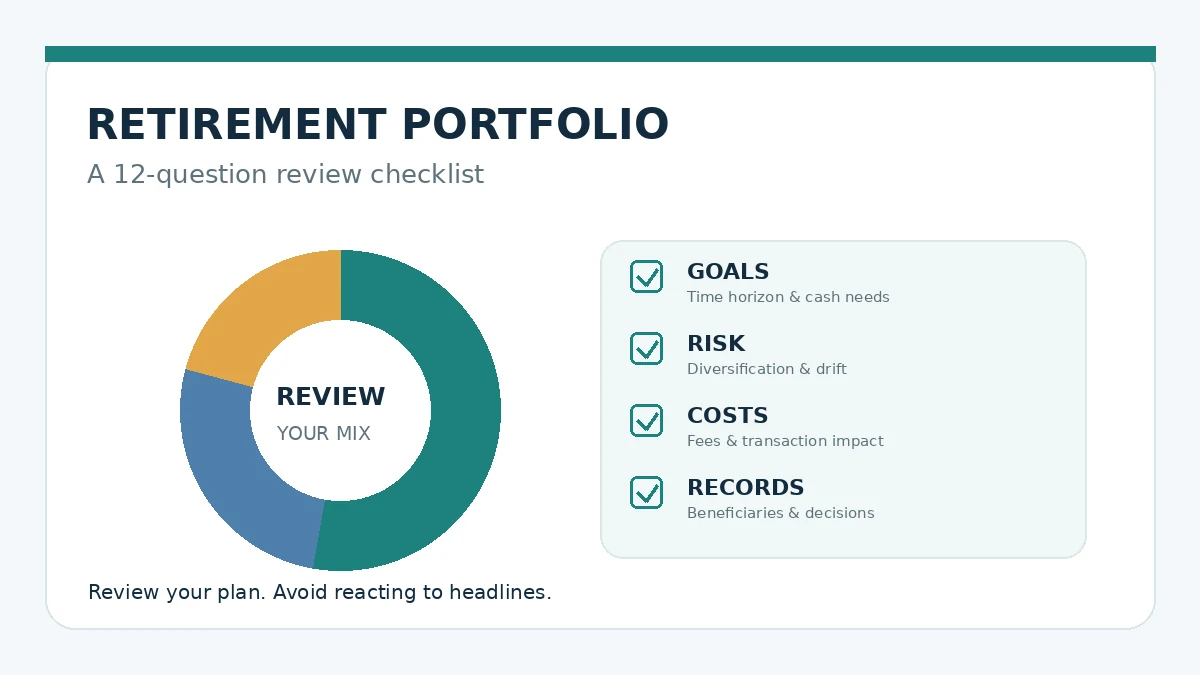
A retirement portfolio review checklist helps you decide whether the investments you already own still fit your goals. It is different from choosing the “best” fund of the year. The useful questions concern your time horizon, overall allocation, risk, costs, account rules and whether a change would solve a real problem.
This guide is educational, primarily for U.S. investors. It does not recommend a particular allocation, security, adviser or account type. Investment values can fall, and tax consequences depend on the account and transaction. Use your plan documents and current disclosures, and consult a qualified professional for decisions with significant tax or legal consequences.
Retirement portfolio review checklist: 12 questions
Set aside a recent statement for each retirement and investment account, your plan’s investment menu if applicable, and a rough estimate of when you may need to start withdrawals. You can complete the worksheet without placing account numbers or other sensitive information into an online form.
| Question | What to check | Action if unclear |
|---|---|---|
| 1. Has my retirement timeline changed? | Expected first withdrawal date, not just a birthday. | Update your planning assumptions. |
| 2. Do I have enough short-term liquidity? | Near-term expenses and emergency resources outside volatile investments. | Separate immediate needs from long-term capital. |
| 3. What is my actual stock, bond and cash mix? | All accounts combined, including funds held inside other funds. | Calculate the combined allocation. |
| 4. Is that mix still appropriate? | Time horizon, financial capacity for losses and comfort with volatility. | Revisit a written allocation policy. |
| 5. Am I diversified within asset classes? | Geography, sectors, issuers and concentration. | Check holdings rather than counting fund names. |
| 6. Are my accounts unintentionally duplicating holdings? | Overlapping index funds or concentrated employer stock. | Compare top holdings and exposures. |
| 7. Has allocation drifted? | Current weights versus intended ranges. | Consider a pre-set rebalancing rule. |
| 8. What fees am I paying? | Fund expense ratios, advisory fees and plan-level costs. | Read the actual disclosures. |
| 9. Would changing holdings create costs? | Trading charges, surrender fees, taxes and restrictions. | Estimate costs before placing orders. |
| 10. Does my target-date fund still fit? | Glide path, underlying holdings, fees and other assets. | Read the prospectus and compare alternatives. |
| 11. Are account beneficiaries and access details current? | Named beneficiaries and secure contact records. | Confirm directly with the plan or custodian. |
| 12. What single decision is justified by this review? | Keep, investigate, adjust contributions or seek advice. | Write the reason and review date. |
1. Start with the retirement date and the first withdrawal
A person retiring in five years but planning to delay withdrawals may have a different investment horizon from someone who expects to use a large portion of savings immediately. Consider expected spending, other income sources and whether you might need money earlier than planned. Do not choose a risk level solely from age. The SEC’s asset-allocation overview explains that both time horizon and risk tolerance matter.
2. Review cash needs separately from long-term investments
Keep the money needed for imminent bills and emergencies in an appropriate liquid form rather than relying on selling volatile investments at a particular market price. The amount and account type depend on your household, access to income and financial obligations. A portfolio review should begin with these practical constraints, not a forecast about the next market rally.
3. Calculate allocation across all accounts
Write down each account’s total value and the approximate amounts invested in stocks, bonds, cash equivalents and other assets. Combine the amounts before calculating percentages. If you hold a target-date fund or a balanced fund, use its reported underlying allocation instead of treating the whole fund as a single category.
For a hypothetical $100,000 portfolio with $65,000 in stocks, $25,000 in bonds and $10,000 in cash equivalents, the allocation is 65%, 25% and 10%. This is a calculation example, not a recommended mix. Compare your result with the policy you previously chose, or use it to begin a discussion with a qualified adviser.
4. Separate willingness to take risk from ability to take risk
You may feel comfortable with market swings but lack the financial capacity to absorb a large loss before a planned withdrawal. Conversely, you may have a long horizon but feel anxious about an aggressive allocation. A review should consider both realities. Avoid relying on a single online questionnaire, especially if the provider sells products that benefit from the suggested allocation.
5. Look beneath fund names to find concentration
Owning five funds does not guarantee diversification if all five hold many of the same large companies. Review each fund’s asset categories, geographic exposures and largest holdings. Sector-specific or country-specific funds may be useful for some strategies, but they can increase concentration if you mistake them for broad diversification. For a deeper comparison, see our niche index fund risk checklist and emerging-markets ETF research worksheet.
6. Check for overlap between retirement and taxable accounts
Some investors own similar funds in an employer plan, an IRA and a brokerage account. That is not automatically a problem, but it makes your combined exposure less obvious. Build a single inventory showing each fund, account, broad asset class and approximate weight. Check whether any employer stock or concentrated position is large enough to change the risk of the entire household portfolio.
7. Decide whether rebalancing is warranted
Rebalancing means bringing a portfolio closer to a chosen allocation. The SEC’s guide to allocation and rebalancing describes approaches based on periodic reviews or preset drift thresholds. Some investors use new contributions to increase underweight categories rather than selling appreciated holdings. There is no universal threshold or schedule suitable for every person.
For example, imagine a fictional plan that began at 60% stocks and 40% bonds. Market movements change it to 70% and 30%. Before trading, ask whether the original target still fits, what account rules apply and whether contributions could reduce the drift. A market move by itself is not proof that you should buy or sell today.
8. Add up all investment and plan costs
Costs may include fund expense ratios, plan administration, advisory charges, brokerage fees and other product-specific expenses. A low visible transaction fee does not mean a product is free. The SEC’s 2025 investor bulletin on fees explains how recurring costs can reduce long-term portfolio value and identifies documents to inspect.
Ask for a fee schedule and look for expenses at multiple layers. Compare services as well as price. An adviser providing useful planning may cost more than a self-directed account, but the fee and scope should be clear. Never assume a historical return projection will offset a known fee.
9. Check tax and transaction consequences before changing holdings
Moving assets within a retirement account, withdrawing money from an account, transferring between account types and selling in a taxable account can have very different consequences. Check restrictions, surrender charges, withholding rules and potential penalties with the plan or a tax professional. Avoid a rushed trade because a headline says a particular asset class is “winning.”
10. Examine target-date funds rather than relying on the year in the name
A target-date fund often adjusts its allocation over time, but funds with similar target years can differ in their glide paths, underlying investments and fees. The SEC’s target-date fund bulletin recommends considering your other assets and reviewing whether the fund’s target date and investment mix fit your circumstances. The fund name is a starting point, not a guarantee of safety or sufficient retirement income.
11. Review beneficiary and account-access information
A portfolio can be well diversified and still create administrative problems if the custodian has outdated contact or beneficiary information. Confirm the current beneficiary designation with each provider and review it after major life changes. Keep account-location information accessible to the right authorized people, but do not place passwords or identification numbers in a public document. Our personal finance documents checklist covers secure record organization.
12. Finish with a written decision, including “no change”
Document the review date, key findings, any missing information and the reason for your next step. A decision to keep the current allocation may be entirely reasonable when your goals and risk limits are unchanged. If a decision is complicated, the next step may be to gather disclosures or ask a qualified professional rather than to place a trade.
A simple 45-minute annual review agenda
Spend ten minutes updating goals and cash needs. Use fifteen minutes to calculate combined allocation and check concentration. Spend ten minutes comparing fees and account features. Use the final ten minutes to record questions, confirm beneficiary details and schedule follow-up. Forty-five minutes is an example of a first-pass review; complex accounts or major life changes deserve more time.
Do not use a retirement portfolio review as a substitute for a full retirement income plan. Withdrawal timing, healthcare costs, debt, taxes and household responsibilities also matter. For a general perspective on saving behavior, see financial independence habits. For evaluating whether one investment manager’s holdings are worth following, see our guide to reading 13F filings.
Frequently asked questions
How often should I review my retirement portfolio?
A periodic review, such as once or twice a year and after major life changes, can be a practical starting point. The appropriate frequency depends on your strategy, account rules and circumstances. Review does not automatically mean trading.
Does rebalancing guarantee better investment returns?
No. Rebalancing is a way to manage drift from a chosen allocation and risk profile, not a guarantee of higher returns. It can involve fees and tax consequences. Consider those costs before making changes.
Is a target-date fund enough for retirement?
It may simplify some investment decisions, but it does not guarantee sufficient income or remove the need to review fees, other assets, risk and spending plans. Read the fund’s prospectus and consider your full financial picture.